
Most corrosion conversations in the oil and gas industry revolve around the usual suspects: CO₂, H₂S, chlorides, microbial activity. These are real threats, and operators prudently invest significant resources managing them. But there is one corrodent that quietly makes every single one of those corrosion mechanisms worse, is rarely mitigated effectively by standard corrosion inhibitors, and can drive a pipeline from manageable degradation to catastrophic failure faster than most models predict.
That element is oxygen.
Why Oxygen in Pipelines Makes All Other Corrosives Worse
Unlike CO₂ or H₂S, which are corrosive within specific chemical environments, oxygen is an equal-opportunity accelerant. It doesn’t pick favorites. Whether your pipeline is fighting carbonic acid corrosion, microbially induced corrosion (MIC), or simple saline pitting, oxygen makes the problem worse, and often dramatically so.
What’s more, oxygen doesn’t simply add to existing corrosion rates. It accelerates them. A pipeline experiencing moderate CO₂ corrosion doesn’t become twice as bad with oxygen present, the interaction is more complex and the outcome often worse than a simple sum would suggest.
Standard oilfield corrosion inhibitors frequently fail to address oxygen effectively, and common mitigation strategies like gas blanketing offer less protection than operators often assume. Oxygen demands its own dedicated mitigation strategy.
The Data Is Clear
Research by A. Ismail (2014) quantified the impact of dissolved oxygen on carbon steel corrosion across three common chemical environments, and the results are striking:
| Environment | Without O₂ (g lost) | With O₂ (g lost) | Increase |
| Sodium Chloride (NaCl / seawater) | 0.009 | 0.220 | +144% |
| Sulfuric Acid (H₂SO₄) | 0.010 | 0.034 | +240% |
| Hydrochloric Acid (HCl) | 0.000 | 0.020 | Infinite |
The HCl result is particularly telling: without oxygen, no measurable steel loss occurred. With oxygen present, significant material loss was recorded. In every scenario tested, oxygen’s presence transformed a manageable situation into a materially worse one.
How Oxygen Attacks a Gas Pipeline
Localized Pitting
Rather than producing the uniform wall thinning that operators can more easily trend and predict, oxygen drives localized pitting – deep, focused attack concentrated at joints, welds, and low-flow zones. This pit morphology is broad, smooth, and overlapping, making it difficult to detect early and harder to remediate once established.
The mechanism is galvanic in nature: oxygen creates the electrochemical conditions for iron to act as the anode, corroding into structurally weak rust. That rust layer, rather than acting as a barrier, is porous enough to allow continued oxygen ingress – meaning the attack is self-sustaining as long as sufficient oxygen is available.
Microbially Induced Corrosion (MIC)
Even trace amounts of oxygen can shift microbial populations inside a pipeline in dangerous directions. Oxygen ingress encourages the proliferation of sulfate-reducing bacteria (SRB) and scaling organisms, which accelerate corrosion and generate deposits that reduce cross-sectional flow area.
As flow restrictions develop, increased shear stress can detach corrosion byproducts and scale downstream, seeding new sites of MIC while continuing the attack at the original location. What begins as an isolated contamination event can become a distributed integrity problem across a significant pipeline segment.
Top-of-Line Attack
In steel pipelines, oxygen tends to accumulate in vapor space at the 12 o’clock position of the pipe, which typically bears a disproportionate share of the damage. Wall thinning concentrated at the top of the pipe is particularly difficult to inspect and can progress rapidly before detection.
As wall thickness decreases, the pipeline’s resistance to fatigue loading drops, crack initiation becomes more likely, and in severe cases the risk of rupture grows substantially.
Downstream Consequences
Oxygen-accelerated corrosion generates rust particulates and scale that don’t stay where they form. These solids travel downstream, fouling valves, damaging compressors, and interfering with processing equipment. The integrity problem becomes an operational problem, causing maintenance costs to rise alongside safety risk.
Pressure, Phase, and the Operating Envelope
The relationship between pipeline pressure and oxygen risk is not linear. At higher operating pressures, oxygen’s corrosive potential in the vapor phase increases, and the window between an acceptable dissolved oxygen concentration and a dangerous one narrows.
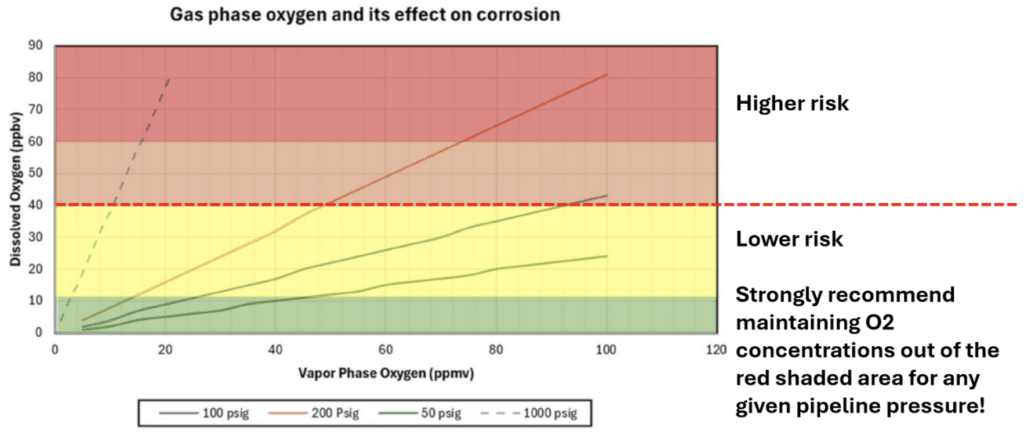
The chart above illustrates how gas-phase and dissolved oxygen concentrations relate to corrosion risk across a range of pipeline pressures. While zero oxygen is the theoretical ideal, practical operations require a working threshold: we recommend keeping dissolved oxygen (y-axis) at or below 10 ppb (parts per billion), which corresponds to a gas-phase oxygen concentration of 40–100 ppmv (x-axis), depending on operating pressure.
Operating above this threshold – particularly at elevated pressures – moves a pipeline into territory where the risk of accelerated degradation grows substantially. Prolonged operation at high pressures with elevated oxygen levels can prove dangerous, even if rupture risk is not immediate. The timing of failure depends on a wide range of external factors, and that uncertainty is itself a reason for caution.
The Role of Water
Oxygen’s corrosive impact is present whether water is there or not, but water increases conductivity and corrosion mechanisms more aggressive. While it is never possible to completely eliminate water from a pipeline, we recommend operators should target a dew point of –40°F or lower to minimize condensation risk. This becomes progressively harder to achieve at lower operating pressures, where gas-drying systems lose efficiency.
Common drying technologies, including adsorbent or desiccant dryers and glycol-based dehydration systems, have tradeoffs at different operating conditions. Selecting the right system for the pressure regime and flow conditions of a specific pipeline is an important part of an effective oxygen management strategy.
DOWNLOAD THE WHITE PAPER: Managing Oxygen Corrosion Risk in Natural Gas Pipelines with ZerO2
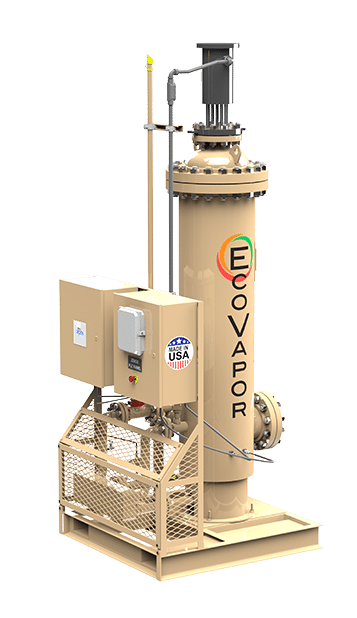
The Solution to Gas Pipeline Corrosion: ZerO2™ Oxygen Removal System
The ZerO2™ oxygen removal system is a proprietary catalytic oxygen removal system specifically engineered for natural gas applications. ZerO2 units eliminate oxygen from tank vapor gas from multiple sources (i.e., oil storage tanks, produced water storage tanks, truck loadouts, etc.), allowing you to sell what is typically the most valuable gas on the well site – high-BTU tank vapor gas – instead of flaring it or losing it to venting.
The ZerO2 system continuously reduces oxygen to below even the most stringent pipeline tariff limits, ensuring compliance even under variable operating conditions. The ZerO2 system can economically achieve the most stringent oxygen concentration restrictions in the U.S., like those imposed by the MPSC in Michigan (<5 ppm) for enhancing public safety and energy security.
ZerO2 technology is reliable, having accumulated a long track record of 99.5%+ mechanical availability from more than 300 units deployed across more than 19 U.S. states serving oil & gas production and biogas operations.
READ MORE: ZerO2 Product Information Page
Takeaways for Operators
Oxygen is not a secondary corrosion concern. It is the one variable that makes every other corrosion mechanism in your pipeline worse, and it requires explicit, dedicated attention in any integrity management program.
Key takeaways for pipeline operators:
- Oxygen plus any other corrodent is worse than either alone. If your pipeline has CO₂, H₂S, chlorides, or biological activity, oxygen contamination escalates the risk from each of those mechanisms.
- Standard corrosion inhibitors are not reliably effective against oxygen. Do not assume that an existing inhibitor program provides meaningful oxygen protection without verification.
- Monitor the 12 o’clock position. Top-of-line corrosion from oxygen accumulation in vapor space is a real and underappreciated threat.
- Maintain dissolved oxygen at 10 ppb or below, implying a maximum working range for vapor phase oxygen between 40-100 ppmv depending on pipeline pressure, and invest in drying technology appropriate for your operating pressure range.
Oxygen doesn’t announce itself the way a high H₂S reading does, and its damage can be well underway before inspection tools catch it. That makes proactive control, not reactive response, the only reliable defense.
For questions about oxygen monitoring, corrosion assessment, or integrity management for your pipeline system, contact our engineering team today.