Clean Gas in a Single Pass.

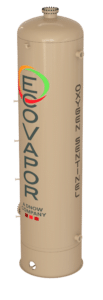
Conventional oxygen decontamination approaches force operators to treat H₂S first, then tackle O₂ separately resulting in two passes and two costs. The Oxygen Sentinel™ is purpose-built for streams with sour gas takeaway where H₂S concentration significantly outpaces O₂ concentration, collapsing dual treatment overhead into a single, unified process.

Benefits of Oxygen Sentinel – Catalytic Oxygen Removal System

  • No asphyxiation risk. Much safer than traditional oxygen chemical scavengers — no asphyxiation potential.
  • No downstream damage. Zero corrosion, zero scaling, no elemental sulfur creation, and no overtreatment potential downstream.
  • Environmentally safe byproduct. Spent catalyst is non-hazardous and non-flammable, making disposal straightforward.
  • Minimal maintenance burden. Catalyst bed life of 6–12 months typically aligns with planned facility maintenance windows.
  • No double-treatment cost. For high-H₂S streams, avoids the expense of treating H₂S and O₂ in two separate steps.
  • High reliability. No moving parts means fewer failure points and consistently dependable operation.
  • Multiple units can be configured to work together, allowing you to scale treatment capacity to changing production volumes.

Oxygen Sentinel Applications

Built for sour gas streams where H₂S dominates

Ideal when the existing H₂S concentration is at least twice the O₂ concentration. Example: 10,000 ppmv H₂S with 30 ppmv O₂ — the catalytic reaction uses H₂S to consume the oxygen.

Applications

Brownfield Oil & Gas Production. Depleted reservoirs are prone to oxygen ingress through aging infrastructure , a critical problem where pipeline operators enforce strict O₂ concentration limits on gas takeaway.

Midstream Gas Treatment. Amine treating units (larger flow rate applications) — oxygen ingress forms heat-stable salts (HSS) in the amine solvent, leading to accelerated corrosion and premature fluid changeout. Removing oxygen upstream protects solvent life and reduces unplanned maintenance.

Operational Characteristics

High-H₂S, low-O₂ sour gas streams. The primary use case. When H₂S significantly exceeds O₂, the Sentinel treats both in a single pass — no sequential treatment trains required.

Facilities planning around existing maintenance cycles. Catalyst bed changeouts at 6–12 months can be scheduled alongside other planned shutdowns to minimize operational disruption.

Sour gas takeaway pipelines and midstream infrastructure. Protects downstream pipelines and equipment from oxygen-driven corrosion and scaling without chemical injection.

Mechanism

Passive catalytic sorbent bed

No power, no pumps. The existing H₂S in the gas stream drives the catalytic reaction that consumes oxygen — no external inputs required.

Catalyst Life

6–12 months, application-specific

Disposable bed. Changeout interval is determined by your specific H₂S and O₂ loading — typically timed with planned maintenance.

Installation

Self-contained, reliable design

Extremely simple to install. The self-contained skid design means no complex field integration or specialized commissioning.

Scalable

Modular, flexible

Multiple units can be connected, allowing you to scale treatment capacity to changing production volumes.

Oxygen Sentinel Spec Sheet

Available options

  • Automated C1D2 self-sampling system
  • Lead/lag vessel design
  • ANSI 600# and custom vessel configurations

Helpful Resources

Oxygen Corrosion Control in Oil & Gas Pipelines – a Case Study

EcoVapor partnered with Permian Basin oil and gas producer, FAC II, LLC (“Forty Acres”), to address oxygen intrusion challenges in their sour gas takeaway for pipeline operations. Forty Acres faced oxygen contamination in their pipelines, which accept sour gas for a nominal fee, limiting their ability to sell gas and requiring costly sulfur treatment beyond…

Read more

Generate More Profits from Your Oil & Gas Production Facility

Proven Techniques for Boosting Production Facility Profitability Today’s oil and gas operators have access to a wide array of tools for enhancing the efficiency and profitability of their production facilities. Yet, many operators still leave untapped opportunities on the table—especially when it comes to maximizing the capture and value of the entire production stream. For…

Read more

DEOXO CASE STUDY: Upgrading Dairy Biogas into Renewable Natural Gas

In this case study, we explore how EcoVapor, a DNOW Company, collaborated with Regenis to create Maine’s first biogas-to-RNG facility for Peaks Renewables, located at the state’s largest dairy farm. The Challenge: Summit Natural Gas of Maine, the RNG buyer, has strict limits on oxygen content, making oxygen removal crucial for commercial sales and pipeline injection.…

Read more

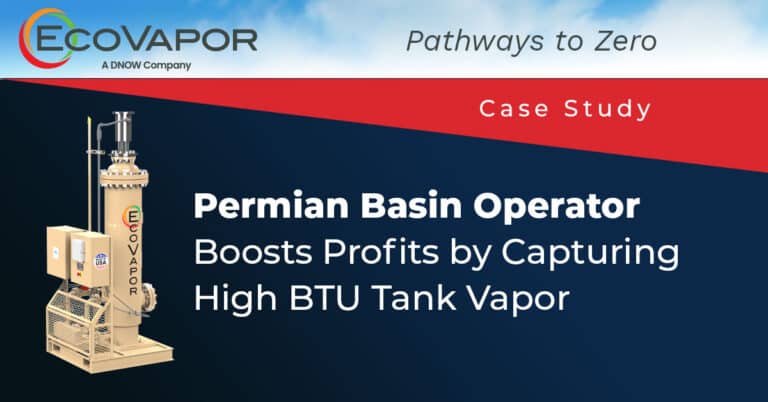
Permian Operator Boosts Profits by Capturing High BTU Tank Vapor with EcoVapor Technology

The Challenge An independent Exploration & Production (E&P) company operating in the Permian Basin region of West Texas sought ways to improve the profitability from its producing operations. The primary objective was to maximize the value of its production stream in a capital efficient way. A key challenge to this goal has been managing tank…

Read more

WEBINAR REPLAY: Living with OOOOb – Strategies and Solutions for Compliance

A Critical Webinar for Facilities Engineers! Replay: An insightful and valuable webinar discussing the implications of the Environmental Protection Agency’s (EPA) final updates to 40 CFR part 60 subpart OOOOb (“quad-o” or OOOOb). The new regulations include sweeping new mandates targeting significant reductions in emissions of methane and VOCs from facilities, well sites, and other…

Read more

VIDEO: Facilities Engineer Talks About Emissions Reduction Technology

Keith Stelter, Chief Strategy Officer with American Safety Services, recently interviewed David Wallace, Facilities Engineering Supervisor with ConocoPhillips. In a wide-ranging discussion, David discusses the challenges his team faced with emissions generated by needing to flare tank vapor gas because of oxygen contamination, and how they solved the problem using EcoVapor ZerO2 technology. Watch the…

Read more

Webinar Replay: Tank Commander™ Vapor Management System Launch Video

Automatic, Active Tank Pressure Management -At Last!Multiple studies demonstrate that venting and flaring from oil and water storage tanks are the leading sources of well site emissions. The EcoVapor Tank Commander™ Vapor Management System solution offers operators a profitable way to convert venting emissions into profits. WEBINAR REPLAY: Tank Commander Vapor Management System: Automatic, Active…

Read more

Shell Featured in IPIECA report entitled “Flaring Management Guidance” Highlighting EcoVapor Technology in the Permian Basin

In December 2021, the International Petroleum Industry Environmental Conservation Association (IPIECA) issued a joint report entitled Flaring Management Guidance as an aid to its members.  The report outlines new developments in flaring management and reduction, and examines industry experiences with eliminating flaring, new technologies, business models, operational improvements and regulatory policy. It also features case studies and…

Read more

EcoVapor In The News – Midland Reporter-Telegram

Ensuring Gas is Pipeline Ready Leads to Zero Routine Flaring The Midland Reporter-Telegram (MRT) interviewed EcoVapor’s Jason Roe and Cody Blair on how our technology is helping oil and gas operators eliminate flaring and venting from tank batteries, helping them boost revenue and achieve their environmental performance goals. Excerpt: “‘This is cash everyone is burning.’…

Read more

EPA Emissions Factors vs. Field Observations – When Theory Meets Reality

Why Are My Well Sites Still Flaring? In light of more stringent emissions rules and environmental performance mandates to achieve net-zero emissions and eliminate routine flaring, current production practices are being reexamined. In our first blog post on the subject Zero Routine Flaring Targets Cannot Be Met Without Addressing Tank Battery Flaring and Venting, we…

Read more

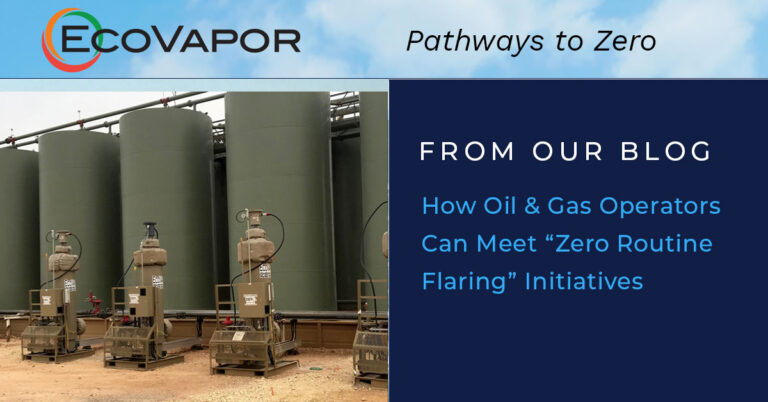
How Oil & Gas Operators Can Meet Zero Routine Flaring by 2030 Initiatives

What is the Zero Routine Flaring (ZRF) Initiative? In light of more stringent emissions rules and environmental performance mandates to achieve net-zero emissions and eliminate routine flaring, current production practices are being reexamined. In 2015, The World Bank launched the Zero Routine Flaring (ZRF) initiative to encourage governments and upstream producers to eliminate the practice…

Read more

WEBINAR! EcoVapor Introduces MobileZerO Solution for Minimizing Emissions and Flaring During Routine Oilfield Operations

About MobileZero Each MobileZerO includes a ZerO2™ E300 unit, a Sulfur Sentinel™ unit and a dehydrator mounted on a trailer for convenient mobilization to well sites and production facilities that require temporary natural gas decontamination and treating capacity. The MobileZerO effectively purifies natural gas and vapors so they meet pipeline specification and can be sold…

Read more

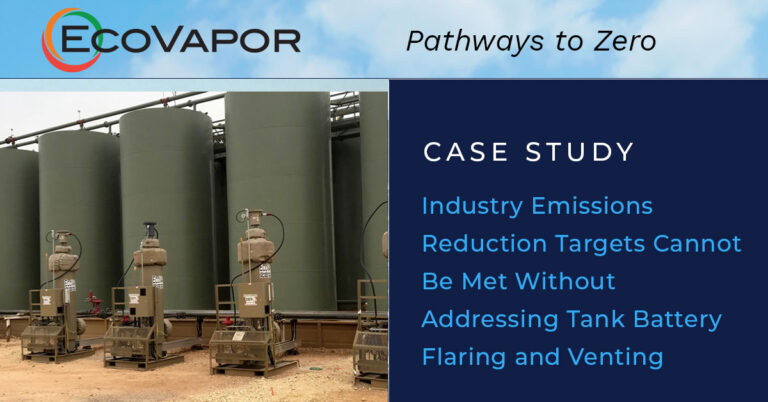
Zero Routine Flaring Targets Cannot Be Met Without Addressing Tank Battery Flaring and Venting

In our Case Study, Zero Routine Flaring Targets Cannot Be Met Without Addressing Tank Battery Flaring and Venting, we cover emissions measurement in more depth and provide a case study demonstrating how one E&P operator discovered tank batteries were the largest source of well site emissions. Download the Case Study Case Study Summary In light of…

Read more

Put Out The Flare and Squeeze More Value from Marginal Production Fields

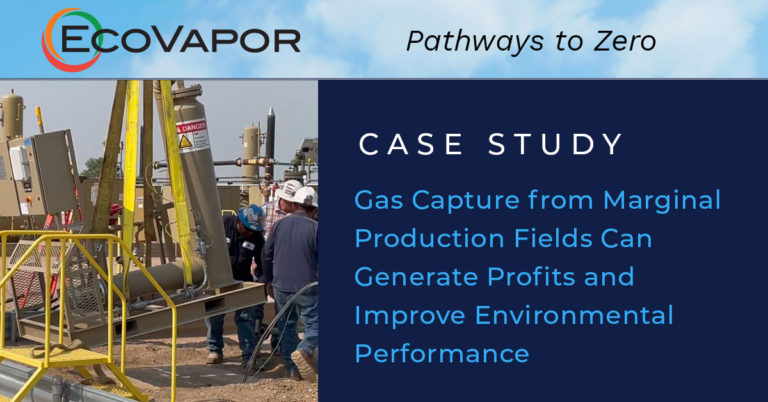
Deploying new technology at older production sites to capture flared gas and reduce emissions can be challenging. Marginal production rates discourage any increase in operating costs, but it can be done – profitably. The operator of a historic field in Texas, a major integrated oil company, approached EcoVapor for help in recovering and selling associated…

Read more

Webinar: Regulatory and ESG Round-Up!

The panel discussion covers: Federal emissions regulations impacting oil and gas operations in active areas Permitting given the interplay between State and Federal emissions limits Impact of compliance on economic and environmental performance Potential for increased emissions restrictions in select non-attainment areas Stay tuned for the lively Q&A session at the end of the webinar!

Read more

WEBINAR REPLAY: Sulfur Sentinel, Packaged Solid Media H2S Treatment Solution

Representatives from EcoVapor and Mesa Applied Technologies discuss the findings of a case study, covering the economic and operational benefits of a Sulfur Sentinel installation with an E&P operator. Key results include a 75% reduction in H2S treatment costs with a one-month payout. The whitepaper will be made available to webinar attendees. For E&P companies…

Read more

Case Study: EcoVapor Enhances Safety of Operations in Water Midstream (SWD)

Ecovapor was recently asked to assist an operator in the Permian “water midstream”, which develops and manages infrastructure for handling produced water from oil and gas production sites. In the recent past, lightning provided an ignition source for the vapors in the atmospheric storage tanks and resulted in significant damage to the site. The force of the detonation also posed a serious safety threat to any operating personnel at the site.

This case study details how ZerO2 units can be used to produce a guaranteed oxygen-free safety blanket that significantly reduces the risk of explosions in Water Midstream (SWD).

Read more

Increased Liquids Production – A Published Study Confirms

Two major E&P companies partnered with EcoVapor to conduct a controlled study for assessing the efficiency, effectiveness and economics of using the latest vapor recovery technology available to operators today. This multi-site test provides a true head-to-head comparison of production sites equipped with the EcoVapor ZerO2 solution and those using only VRUs or VRTs. On…

Read more

Today, well over 300 ZerO2 units are working reliably in the most active oil and gas producing areas in the U.S.,

…including the Permian Basin, Eagle Ford shale trend, Marcellus shale play, DJ Basin, Midcontinent region and the Bakken oil shale.

Get in Touch

Contact us today to learn how EcoVapor and ZerO2 is right for your operation.

Table of Contents