
The Permian Basin is no stranger to stormy weather. Every spring and summer, powerful thunderstorms roll across the flat West Texas landscape, bringing heavy rain, hail, and significant lightning. For the oil and gas operators running tank batteries across Midland, Ector, and the surrounding counties, those lightning strikes represent one of the most immediate and destructive hazards in the oil patch.
Just recently, on May 20, 2026 lightning ignited a massive fire at a tank battery south of State Highway 1285 in Midland County. Thick black smoke billowed into the sky and could be seen from miles away as emergency crews raced to the scene. This was not an isolated incident, as other fires suspected to be ignited by lightning also occurred.
A Recurring Lightning Related Problem in the Permian
Tank battery fires are not a new concern in West Texas, they are a recurring one. As Midland County fire investigator Justin Bunch has explained, the region has seen several such fires in recent years, with severe weather being the most common trigger. The physics are straightforward: when lightning strikes a fixed-roof storage tank, it can blow the dome lid off and immediately ignite the vapors inside. “If lightning strikes them,” Bunch noted, “it’s just going to blow the lid off and catch fire.”
What makes this especially difficult is that there is no single, clean solution once a fire starts. Bunch has been candid about the complexity responders face: sometimes the safest course of action is to let the fire burn itself out rather than risk putting firefighters in harm’s way. “Sometimes it’s best to just let it burn,” he told NewsWest 9. Emergency crews must wait for company representatives to arrive to understand what chemicals are in the tanks, whether nearby wells need to be shut in, and whether product is still flowing into the burning battery. The public, meanwhile, is urged to keep well clear.
The infrastructure density of the Permian makes this risk hard to avoid. The basin produces roughly half of the nation’s oil, and the landscape is blanketed with storage tanks, pumpjacks, and production facilities – most of them sitting in open, flat terrain with little shelter from the electrical storms that sweep through each year.
The Fire Triangle – The Chemistry of Catastrophe
To understand why lightning is so dangerous at a tank battery, it helps to understand what is actually happening inside those tanks. Crude oil storage tanks accumulate hydrocarbon vapors in the headspace — the air gap between the liquid surface and the roof. Those vapors mix with oxygen that enters the tank through pressure-vacuum vents and other openings, creating a flammable mixture sitting in an unprotected metal container in the middle of an open field.
The Fire Triangle consists of three ingredients:
- Fuel: material that can be converted into heat energy through combustion
- Heat: provided by an ignition source to initiate the fire
- Oxygen: to create a chemical reaction with the fuel

This is commonly called the fire triangle. As tank vapors and oxygen flash off in storage and accumulate in the headspace, two of those three elements are continuously present in storage tanks. All it takes is an ignition source — a lightning strike, a static spark, an equipment failure — to complete the triangle.
When that happens during a storm, the result is exactly what Midland County witnessed on May 20th: a fireball, a column of black smoke, and a battery of tanks that emergency crews can only watch burn.
To prevent or stop an explosion or fire, we need to “break” the Fire Triangle by removing one of the three ingredients.
A Proactive Solution: Remove Oxygen Before the Storm Arrives
The traditional approach to tank battery safety focuses on managing what happens after ignition — better firefighting infrastructure, faster emergency response, smarter containment. But a growing number of Permian Basin operators are rethinking the problem at its source: instead of waiting for the fire triangle to complete, they are breaking it before it can form.
Although engineers go to school for years to learn how to build an efficient and safe facility, it is difficult to overcome physics even in the best designs. Tanks will naturally “breathe” with fluctuations in pressure. These can be caused by changes in temperature or material entering or exiting the tank(s). These pressure fluctuations can draw in atmospheric gases (i.e., air and all its constituents) through a vacuum relief when material is removed from the storage tank.
ZerO2 Oxygen Removal Technology
Our patented ZerO2 oxygen removal system uses a catalytic process to eliminate oxygen from tank vapors. By eliminating oxygen from the tank vapor gas, the system removes one of the three requirements for combustion — and a fire that cannot form cannot be ignited by lightning or anything else.
The EcoVapor ZerO2 oxygen removal system harnesses catalytic processes to safely and efficiently remove oxygen from tank vapors. Our reliable, patented technology eliminates oxygen from tank vapor gas in gas blanketing operations, significantly mitigating ignition risk in storage tanks.
The ZerO2 system works by leveraging catalytic heat to safely convert oxygen into inert byproducts, primarily carbon dioxide and water vapor. Critically, the units have no moving parts, carry a C1D2 rating for use in hazardous environments, and have demonstrated greater than 99.9% runtime availability across hundreds of deployments. Beyond the safety benefit, operators also gain the ability to recover and sell the high-BTU tank vapors that would otherwise be flared or vented — turning a safety investment into a revenue stream.
EcoVapor ZerO2 technology supports a proactive approach to tank battery fire risk reduction: rather than extinguishing a fire after it is detected, the system prevents ignition from being possible in the first place. One of the most effective ways to break the fire triangle is to remove oxygen from the accumulated vapors, and catalytic oxygen removal does exactly that — safely and continuously.
Oxygen Removal – Breaking the Fire Triangle in Oil and Produced Water Storage Tanks
One of the most effective ways to break the Fire Triangle and mitigate the risk of fire and explosion is to remove oxygen from the accumulated tank vapors. Catalytic oxygen removal is a safe and effective method of deoxygenating tank vapors.
Use Case: ZerO2 Combustion Mitigation for Oil and Gas Operator
ZerO2 technology is being used in the Oil and Gas industry specifically for mitigating combustion risk at production facilities.
The flow diagram below illustrates the configuration of a tank battery using a ZerO2 unit to deoxygenate tank vapor gas at a production facility using multiple above ground crude oil storage tanks.
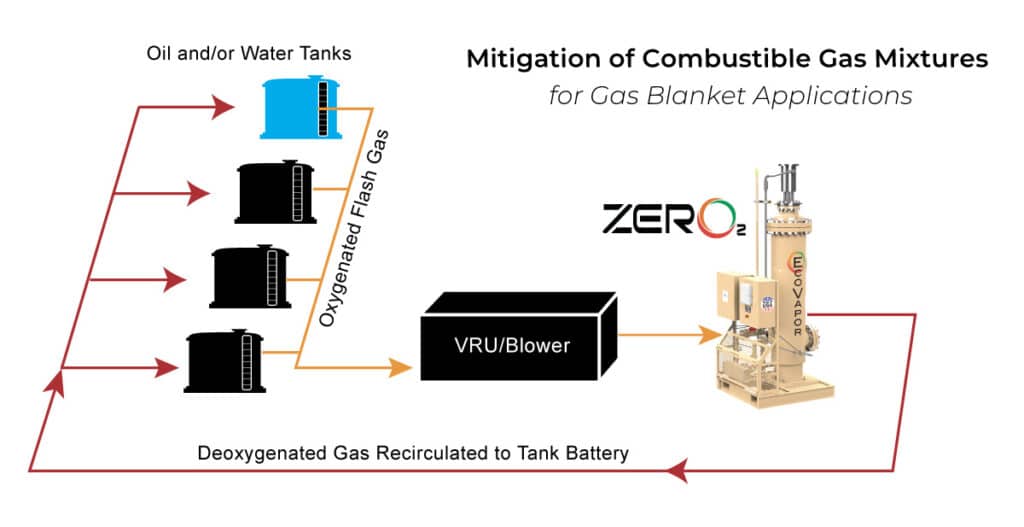
Tank vapor gas from a Vapor Recovery Unit (VRU) is routed to the ZerO2 for deoxygenation. The deoxygenated gas is routed back into the tank headspaces as an oxygen-free “gas blanket,” effectively breaking the Fire Triangle.
Scale, Flexibility, and a Permian Track Record
For Permian Basin operators evaluating vapor management technology, the practical questions are usually about scale, reliability, and economics. EcoVapor’s ZerO2 lineup addresses all three.
Units are available in sizes capable of treating between 20 and 2,000 MSCFD of tank vapor, and multiple units can be deployed in parallel to accommodate larger facilities. The modular design also allows operators to scale treating capacity to changes in vapor volumes over the production life of a well, meaning the technology can follow an asset from peak production through its tail end without requiring significant re-investment.
The Broader Picture – A Safety Investment That Makes Money
The May 2026 Midland County tank battery fire is a reminder that the hazards facing Permian Basin infrastructure go beyond well control and equipment failures. Severe weather, and the lightning that comes with it, is a recurring, predictable threat that arrives every storm season. Operators who plan around it proactively are in a better position than those who respond to it reactively.
There is no single technology that eliminates all risk at a tank battery. Lightning protection systems, proper grounding, pressure management, and emergency response planning all have roles to play.
But vapor recovery technology like EcoVapor’s ZerO2 system adds a layer of protection that directly targets the mechanism by which most weather-related tank fires start: a flammable vapor-air mixture waiting for a spark. And, ZerO2 allows you to always meet pipeline specification so you can sell BTU-rich, valuable tank vapors instead of flaring them.
West Texas will continue to have storms. The question for operators is whether their tank batteries will continue to have the conditions that turn those storms into fires.
Ready to break the fire triangle and eliminate tank flaring? Contact us today to speak with an engineer about our oxygen removal solutions.
Summary
Catalytic oxygen removal from tank vapors is a safe and effective way to break the Fire Triangle and significantly reduce the risk of explosion and fire from enclosed liquid storage tanks at SWD facilities and other industrial operations.
Contact us today to learn more about how EcoVapor technology can help you mitigate the risk of fire and explosion from SWD storage tanks.
About EcoVapor
EcoVapor Recovery Systems, a DNOW Company, headquartered in Denver Colorado, delivers advanced technology-based solutions to the energy sector, including oil and gas, renewable natural gas, and hydrogen production. Our solutions help operators convert waste streams into revenue, reducing emissions while increasing economic performance.
Contact
Joe Hedges
Director of Sales
EcoVapor Recovery Systems, a DNOW Company
7402 N. Elderidge Parkway, Houston, Texas 77041
E: joe.hedges@dnow.com
O: 844-NOFLARE (844-663-5273)