
While the phrase in the title clearly dates the author, its enduring truth resonates just as powerfully today as it did in the past.
Recently Climeworks started up their CO2 capture plant named Mammoth in Iceland.
“Mammoth will be able to pull 36,000 tons of carbon from the atmosphere a year at full capacity,” according to Climeworks. “That’s equivalent to taking around 7,800 gas-powered cars off the road for a year.” Climeworks did not give an exact cost per ton of carbon removed, but indicated it was closer to $1,000 than $100 a ton – the latter of which is widely considered a key threshold for making the technology affordable and viable.
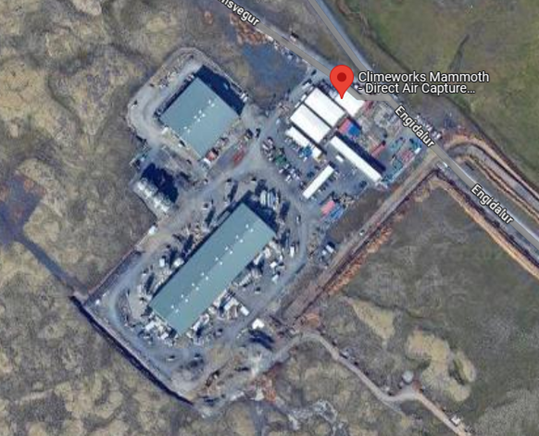
During a call with reporters, Jan Wurzbacher, co-founder and co-CEO of Climeworks, outlined the company’s strategy to achieve economies of scale and reduce costs by expanding plant size. Their goal is to achieve a cost range of $300 to $350 a ton by 2030 before hitting $100 a ton around 2050.
READ MORE: Climeworks Announcement: Mammoth: our newest facility
Putting Mammoth in Perspective
At EcoVapor we support innovative solutions such as Climeworks Mammoth plant. The company’s announcement, however, provides clarity to the relative costs and complexities of preventing CO2 from entering the atmosphere today versus working to remove it from the atmosphere later on.
For example, one EcoVapor E300 with 300 MCFD of treating capacity can capture and prevent 16,000 metric tons per year of CO2 from entering the atmosphere from Oil and Gas production sites, assuming the captured gas been flared instead.
The Mammoth plant started up with 12 of the planned 72 capture systems operating, so it is currently removing an estimated 6,000 tons CO2 annually, less than half of the CO2 that just one E300 prevents.
When completely operational, the Mammoth plant will remove the equivalent of just over two E300 units. For comparison, one multi-horizontal well site in the DJ Basin is usually equipped with two E300 units.
Given that EcoVapor has approximately 300 units operating across the United States today, our current treating capacity is equivalent to approximately 120 Mammoth plants.
There’s also a significant difference in costs. Climeworks is estimating their costs are “closer to $1000 than $100 per ton” with a goal to reach $300 to $350 a ton by 2030. By comparison, a single EcoVapor E300, coupled with a 3rd party VRU, prevents CO2 emissions at a cost of about $6.10 per metric ton, or 99.5% less than Climeworks’ current costs and 98.5% less than the 2030 goal of $300 to $350 per ton. Assuming that the tank vapors are captured and sold instead of flared, the net cost in most cases is negative since the incremental revenue from selling valuable BTU-rich tank vapors more than offsets the operating expense.
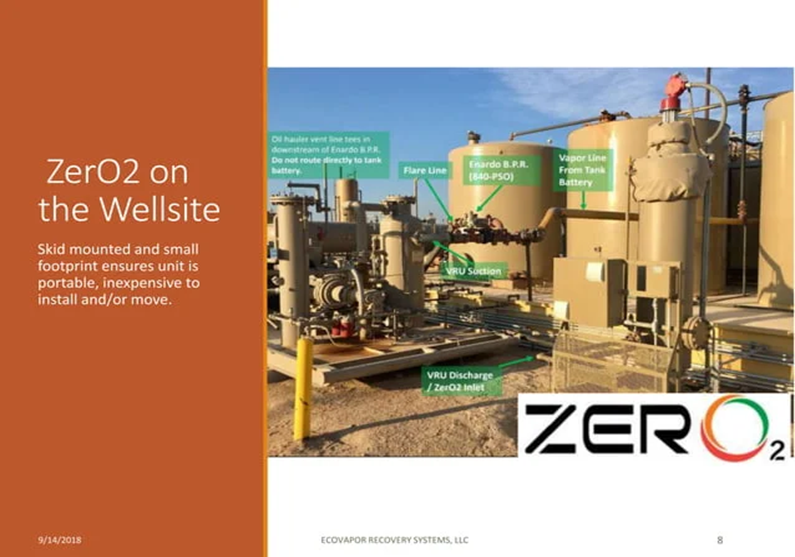
The footprints of each technology are very different. The Mammoth plant takes up approximately 480,000 square feet of land whereas an EcoVapor E300, coupled with a VRU, takes up about 100 square feet, or 99.8% less land.
READ MORE: The ZerO2™ Vapor Recovery System
CO2 prevention and CO2 capture are complementary technologies. The EcoVapor ZerO2 fleet prevents the flaring and venting of tank vapor gas having oxygen levels that exceed pipeline specification, a very specific source of emissions, as compared to the Climeworks Mammoth project which captures CO2 from all sources (e.g., livestock, decaying matter, automobiles, etc.) We support Climeworks and other CO2 capture systems. However, these simple comparisons show that an ounce of prevention is actually equivalent to tons of cure.
The EcoVapor Difference
- We don’t make you choose between meeting environmental performance goals and generating financial results – with EcoVapor you can achieve both.
- EcoVapor offers a complete lineup of environmental performance solutions to help you achieve net-zero emissions without sacrificing economic results.
Contact us today to learn more about EcoVapor technology can help you significantly reduce well site emissions while generating more revenue.
About EcoVapor
EcoVapor Recovery Systems, a DNOW Company, provides solutions to pressing oil and natural gas production problems. EcoVapor’s technical team has extensive expertise in vapor recovery processes, and includes world-class engineers with an innovative approach to industry challenges. In over 120 installations in all major US basins, our patented ZerO2 solution helps oil and gas producers meet their air emissions and regulatory compliance goals. EcoVapor is headquartered in Denver, Colorado and has field locations in Greeley, Colorado and Midland, Texas.
Contact
Joe Hedges
Director of Sales
EcoVapor Recovery Systems, a DNOW Company
7402 N. Elderidge Parkway, Houston, Texas 77041
E: joe.hedges@dnow.com
O: 844-NOFLARE (844-663-5273)