Interest in upgrading biogas to Renewable Natural Gas (RNG) in the U.S. is driven largely by its potential for a negative carbon footprint. Unlike traditional energy sources, biogas captures methane emissions from decomposing organic waste—such as that found on farms and in landfills—that would otherwise escape into the atmosphere. This process not only generates hydrocarbon gas for onsite heat and power but also helps mitigate potent greenhouse gas emissions. When purified, RNG becomes a direct substitute for conventional natural gas, reducing the environmental impact associated with extracting and operating geologic oil and gas wells. Additionally, biogas production from animal waste yields a valuable byproduct known as “digestate,” which can be repurposed as fertilizer, animal bedding, or a soil amendment. As a leading provider of purification technology for the biogas industry, EcoVapor plays an active role in advancing this sustainable energy solution.
Biogas Production
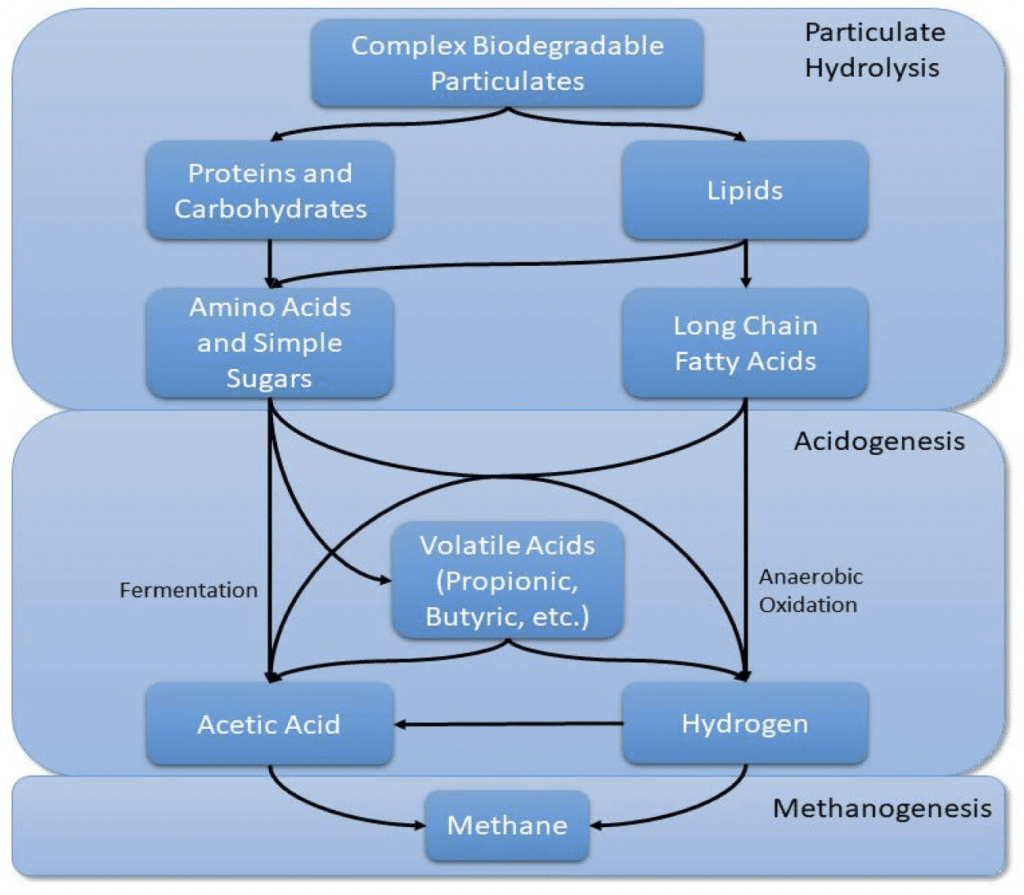
Biogas is produced through the decomposition of organic matter, with common sources including landfills, dairy and swine farms, and wastewater treatment facilities. Microorganisms break down the organic material, consuming the carbon, hydrogen (H₂), oxygen (O₂), and nitrogen (N₂) to support their growth. When this process occurs in the presence of oxygen (aerobic conditions), the primary byproducts are carbon dioxide (CO₂)—a greenhouse gas—and water. However, when oxygen is absent (anaerobic conditions), the process yields a mixture of methane (CH₄) and carbon dioxide, which together form biogas.
The three phases of the anaerobic process are depicted graphically below (Source: AgSTAR Project Development Handbook, 3rd Edition, EPA 430-B-20-001):
Biogas Quality and Purification
While biogas is commonly used for generating site power and heat, biogas in its raw form is not a substitute for commercial natural gas due to its relatively low methane (energy) content and the presence of various contaminants.
Typical biogas consists of 40–60% methane, with the remainder primarily composed of carbon dioxide, along with inert gases like nitrogen and trace levels of harmful contaminants. Biogas purification—also known as upgrading—involves removing these non-methane components to increase methane concentration and meet the quality standards required for injection into commercial natural gas pipelines.
Composition of Biogas versus Renewable Natural Gas
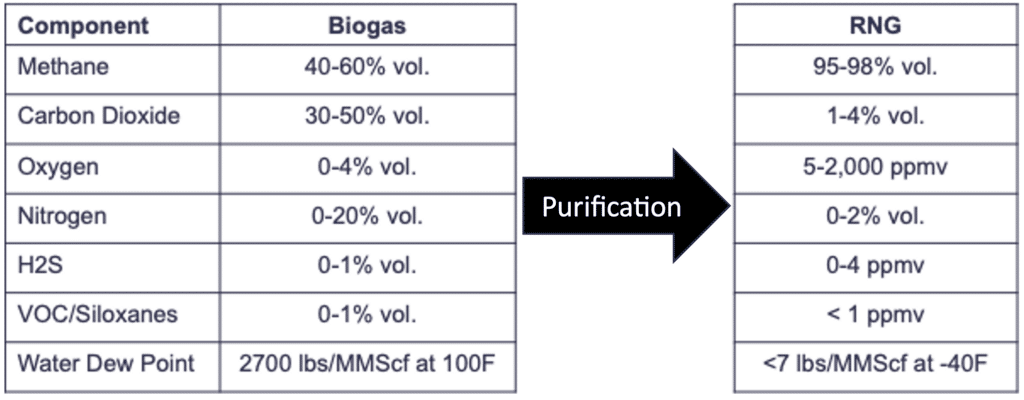
Not all these components affect the gas quality in the same way:
- Carbon dioxide, nitrogen, and water reduce the proportion of methane and the heating value (i.e., energy content) of the biogas.
- Water must also be removed to prevent both freezing and corrosion issues. Oxygen is known to be corrosive in pipelines and equipment and can negatively impact gas purification processes.
- Hydrogen sulfide (H2S) is also corrosive and highly toxic.
- Finally, volatile organic compounds (VOCs), H2S, and siloxanes can negatively impact downstream treating processes by damaging membranes used in CO2 removal and poison adsorbent medias and catalysts. Siloxanes can also impair downstream equipment due to sand deposition.
Biogas Purification Technologies and Process
The biogas purification process varies in terms of treating requirements as well as methods. Conditions affecting the design of the purification process include:
- Source of organic material (landfill, wastewater, swine, dairy, poultry, etc.)
- Degree of degradation of source organic material (e.g., manure collected from a field vs. in a dedicated collection facility)
- Digester design and agitator efficiency
- Feedstock volume
- Cost of power and materials
- Location and permitting requirements
- Planned use of the RNG (transmission pipeline, vehicle fuel, etc.)
- Project economics
- Pipeline or end use specifications (including tolerances of impurities)
Despite the variations in the purification process, most biogas to RNG facilities include several, but not necessarily all, of the treatment steps outlined in the diagram below.
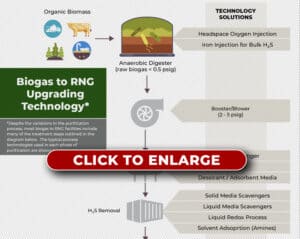
While there are many variations in biogas purification, almost all include hydrogen sulfide (H2S), water and CO2 removal, since these are natural products of the anaerobic digestion process and contained in the raw biogas. As mentioned previously, H2S is toxic and must be removed, and water and CO2 concentrations significantly reduce the energy content, or heating value, of the biogas.
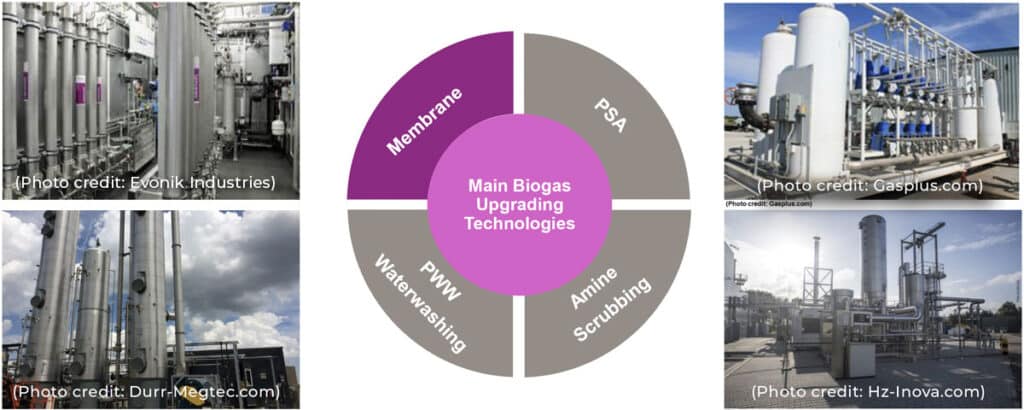
Many of the process technologies use some form of solid or liquid media to purify the biogas, and regenerative media is preferred in operations with higher gas volume. Membranes are now widely used for CO2 removal and can also reduce the concentration of oxygen and nitrogen. Pretreatment for H2S and volatile organics is required.
Dealing with Oxygen Contamination
Oxygen is nearly always present in biogas, but removal is not always required. Some commercial pipelines have more permissive gas specifications, allowing higher concentrations of oxygen. In some cases, pipeline specifications for oxygen can be achieved as a tangential benefit of using membranes and adsorption units for CO2 removal process, which can also remove varying degrees of oxygen and nitrogen.
In the catalytic oxygen purification process used by EcoVapor, oxygen is consumed in the chemical process of creating the reaction products of carbon dioxide and water. Since the gas requiring O2 removal typically contains less than 5000 ppmv oxygen, the contribution of carbon dioxide from the catalytic reaction is generally very minimal.
Traditionally, natural gases are quantified by a calorific heating value, but because biogas does not have the same impurities as conventional natural gas, the Wobbe Index is traditionally used. Variations in CO2 concentration do change the Wobbe Index, but generally not sufficiently to land outside of the 1290 to 1400 that is typical for RNG.
EcoVapor Technologies for Biogas Purification
EcoVapor has been actively involved in treating gas in the oil and gas sector for more than a decade, and our ZerO2 deoxo solution is available in several sizes with capacities ranging from 70 to 1400 scfm. EcoVapor ZerO2 units are currently operating in biogas purification facilities across the country. EcoVapor also offers H2S removal equipment using solid media, which like the ZerO2, was originally developed for use in the U.S. natural gas industry. The company’s engineering team is actively developing RNG-specific products and has service technicians to assist with the installation, commissioning, and maintenance of the company’s purification equipment.
About EcoVapor
EcoVapor, a DNOW company, provides gas treating solutions to both geologic and biogas production problems. Our fleet of proprietary ZerO2 oxygen removal (deoxo) units has grown to a fleet of over 300 since 2010, operating reliably for leading producers in all major U.S. basins. ZerO2 technology helps Oil & Gas and biogas producers convert waste gas streams into revenue by treating gas to meet pipeline specifications so it can be sold instead of vented or flared, generating incremental value while reducing emissions and improving environmental performance.
EcoVapor is headquartered in Denver, Colorado and has field locations in Greeley, Colorado and Midland, Texas.
Contact
EcoVapor Recovery Systems (a DNOW Company)
Email: ecovapor.info@dnow.com
Phone: 844-NOFLARE (844-663-5273)
Sales: Joe Hedges (281-615-2072)