
With profit margins under pressure, operators need to squeeze every Mcf of production they can out of their producing assets. The margin between hitting budget and falling short often lies in how well you capture the entire production stream, not just the crude oil and wellhead gas, but also the vapor losses from oil storage tanks, produced water tanks, surge vessels, and flash emissions. Tank vapor gas, rich in valuable heavy hydrocarbons, represents low hanging fruit just waiting to be picked as profits instead of flared or vented, leaving value on the table.
EcoVapor’s suite of tank vapor capture and oxygen removal technologies is designed to stop that waste and convert vapor losses into revenue, while also lowering emissions, simplifying compliance, and improving the operational efficiency of your production sites.
This article covers simple ways you can stop wasting valuable products and provides an example of how an EcoVapor customer is making more money from vapor capture than it is from primary gas sales.
The Problem:
There are several reasons why flaring or venting tank vapors burn away profits:
- Vapor is rich in BTU value. Tank vapors that flash off crude or condensate during tank storage often carry a disproportionate share of the heavier hydrocarbons, including propane, butane, pentanes, and other natural gas liquids (NGLs). These are among the highest-value components in your gas stream. When vapor containing high BTU content is flared or vented, it turns what is typically the most valuable gas on the well site into waste instead of marketable production.
- Oxygen and other contaminants prevent gas sales. If vapor remains in the tank headspace for too long, oxygen and other contaminants come out of solution and can reach high levels of concentration. If the oxygen content exceeds the sales line specification, then the valuable vapor must be flared off for pipeline safety. That represents a waste of valuable product.
- Regulatory, environmental, and safety costs. Uncontrolled vapor emissions create VOC, NOₓ, and greenhouse gas liabilities, risk air permit violations, and increase community and regulatory scrutiny. Flaring and venting also detract from corporate environmental performance objectives.
- Inefficiencies in tankless or surge systems. In production systems without storage tanks (tankless designs), flash gas or surge emissions must be handled carefully to maintain stable pressures. Conventional VRUs (vapor recovery units) can be oversized, costly, or inefficient resulting in higher than needed operating expenses.
Combined, these challenges represent both wasting money and risking non-compliance. The question becomes: can you economically capture and monetize high-value tank vapor without undue complexity or expense?
Case in Point: Turning Lost Tank Vapors into Profit
In the heart of the Permian Basin, an independent E&P company was on a mission to squeeze more value from its producing assets. The goal was simple but ambitious – increase profitability of its brownfield operations without increasing capital expenditures on new drilling or recompletions.
But one stubborn challenge kept standing in the way: tank vapors.
These vapors, rich in natural gas liquids (NGLs), represented a hidden goldmine, up to 20 GPM making it the most valuable gas stream on the well sites. Yet instead of adding to the bottom line, most of it was literally going up in flames. High oxygen levels in the tank vapor routinely exceeded pipeline specifications, forcing the operator to flare the gas and burn away profits and degrade environmental performance.
The team threw everything they had at the problem. They tried gas blanketing, tightened LDAR programs, wrapped pipes, and sealed every fitting and connection they could find. Still, oxygen levels rarely met the pipeline specification.
A temporary deal with their midstream partner to relax oxygen limits provided a bit of breathing room, but it was not a long-term fix. Blending tank vapors with wellhead gas helped lower oxygen content, but this practice diluted the BTU-rich stream, trading value for compliance and cutting into overall profitability.
Despite their best efforts, the operators are sometimes forced to flare off one of their most lucrative resources, and the ever-present tank flare was a daily reminder that even small inefficiencies can have an outsized impact on production economics.
After everything else failed, the company opted for the EcoVapor ZerO2™ oxygen removal system to treat the rich tank vapor gas, ensuring oxygen levels comply with pipeline specifications for direct sale rather than resorting to blending or flaring.
Importantly, the operator installed a dedicated custody transfer meter for the recovered gas stream, enabling precise measurement of both volume and gas composition, ensuring full capture of the value from heavy hydrocarbons such as propane, butane, pentane, and hexane+ present in the tank vapor.
The operator confirmed that the revenue from the high-BTU captured tank vapor was significantly more valuable than that of the wellhead natural gas sold to the gatherer.
The ZerO2 vapor recovery system combined with a dedicated custody transfer meter for the rich tank vapor stream delivered several benefits:
- Improved profitability from capturing BTU-rich tank vapor and selling it at a premium price, even in low commodity price environments, instead of wasting it.
- Reduced emissions by reliably eliminating routine tank flaring at sites equipped with ZerO2 treating capacity.
- Enhanced economics for brownfield sites, by commingling tank vapor streams from multiple locations into a centralized ZerO2 treating location.
Flash Gas Capture: Approaches That Work
EcoVapor’s approach is to help you capture 100% of the value of your production stream to maximize the profitability and efficiency of your production operations.
Tank Storage (Crude Oil and Produced Water)
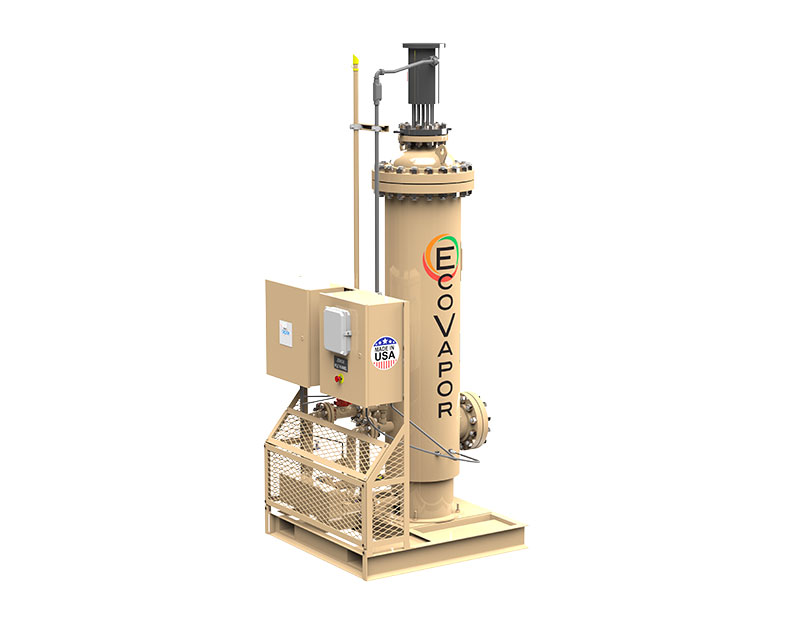
For tank systems, EcoVapor’s ZerO2™ oxygen removal unit, when paired with a VRU, allows full capture of the tank vapor stream. The process is:
- A VRU pulls vapor off the storage tanks (or flash system)
- That vapor is routed into the ZerO2 unit
- ZerO2 removes or reduces oxygen (and other contaminants) to meet pipeline specs
- The treated vapor is then eligible for direct sale or line injection
By making formerly off-spec vapor saleable, you unlock the BTU value that would otherwise be flared and wasted.
(Flash Gas Capture)
Tank Storage (Crude Oil and Produced Water)
For tank systems, EcoVapor’s ZerO2™ oxygen removal unit, when paired with a VRU, allows full capture of the tank vapor stream. The process is:
- A VRU pulls vapor off the storage tanks (or flash system)
- ZerO2 removes or reduces oxygen (and other contaminants) to meet pipeline specs
- That vapor is routed into the ZerO2 unit
- The treated vapor is then eligible for direct sale or line injection
By making formerly off-spec vapor saleable, you unlock the BTU value that would otherwise be flared and wasted.
Tankless Systems
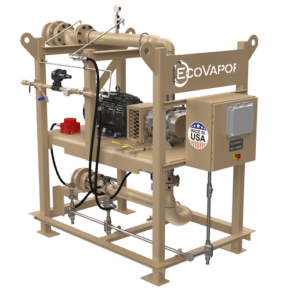
For tankless or surge-based production facilities, the EcoForce™ Vapor Management System (VMS) is a continuous, variable-speed blower system that:
- Maintains surge vessel or flash tank pressure to prevent vapor loss
- Recovers 100% of flash gas / vapor, sending it into the sales line
- Can also boost flare line pressure if needed to improve flare performance
Because EcoForce is dynamic and continuously modulated, it avoids the “one-size-fits-all” overcapacity inefficiencies of traditional VRUs in these contexts.
Quantifying the Value: How Much Profit Can You Unlock?
Here’s a simplified approach to estimate the upside from integrating EcoVapor:
- Baseline vapor loss. Estimate how many standard cubic feet of vapor you currently flare, vent, or downgrade.
- BTU potential uplift. Determine how rich that vapor is in heavier hydrocarbons (higher BTU content).
- Recoverable fraction. With EcoVapor, assume you can recover a high percentage (90-98%) of that vapor stream for sale (depending on your starting capture losses and system design).
- Incremental revenue = (Recovered volume) × (BTU uplift) × (gas price / scf)
- Avoided costs & penalties. Factor in avoided emissions costs, carbon or regulatory charges, and cost savings from downstream blending or flaring expenses.
- Capital & operating cost. Subtract the incremental capital expenditure (or lease payment) and operating costs of the EcoVapor system over its life.
- Net present value (NPV). In nearly every case, the NPV of installing EcoVapor technology is not only positive, but often yields significant increases in profits and economic value.
Importantly, our systems scale to your changing production needs. We offer various capacity tiers, allowing you to right-size for early production and scale down operating cost to align with natural production declines, creating a true “life of well” solution.
How to Pick the Right EcoVapor Solution: Using the Product Selector
Because every site design is unique (i.e., tanks vs tankless, H₂S content, throughput, permit constraints, etc.), EcoVapor provides a Product Selector tool to help guide solution choice.
Here are some pointers for how to use it effectively:
- Define your site configuration: Is it a tank-based pad, or a tankless production facility? Do you have gas gathering or pipeline tie-in already?
- Check gas quality constraints: Do you have oxygen, H₂S, or other impurities that must be treated?
- Estimate capacity needs: What is your vapor generation rate (in Mcf/d)? What’s your expected throughput range over life of well?
- Locate your operational scenario on the selector matrix: The tool maps configurations to appropriate solutions like ZerO2, EcoForce, Tank Commander™, or Sulfur Sentinel™.
- Scale for life-of-well: As production declines, the selector helps you choose a system whose operating cost scales down, avoiding overcapacity drain during late-life phases.
By running through the selector with your site’s parameters, you can identify which EcoVapor system offers the better economic fit.
LEARN MORE: ECOVAPOR PRODUCT SELECTOR
Conclusion – Stop Flaring Flash Gas and Boost Profits!
EcoVapor has helped producers across the U.S. convert tank vapors into measurable profits, improving cash flow, compliance, and sustainability in one simple step.
The only question left is: How much profit can you generate from the gas you’re already producing?
Contact EcoVapor today to see how quickly you can transform tank vapor losses into lasting profitability.