Managing Oxygen Corrosion Risk in Natural Gas Pipelines with ZerO2
Oxygen is a contaminant that can quietly threaten natural gas pipeline integrity, creating the conditions for catastrophic pipeline failures with consequences for safety, assets, and business continuity. Even in small concentrations, oxygen can significantly accelerate every form of corrosion in steel oil and gas pipelines, resulting in operational risks, increasing maintenance costs, and in extreme cases contributing to catastrophic failures.
The risks of oxygen contamination are not theoretical. The Carlsbad, New Mexico, pipeline rupture on August 19, 2000, resulted in multiple fatalities and highlighted the consequences of internal corrosion and inadequate gas quality management (Pipeline Accident Report NTSB/PAR-03/01).
In our new white paper Managing Oxygen Corrosion Risk in Natural Gas Pipelines Using ZerO2™ Technology we cover:
- Why natural gas steel pipelines corrode
- Corrosion mechanisms in steel pipelines
- The role oxygen plays in pipeline corrosion
- How oxygen enters oil & gas production systems
- The rationale for oxygen specifications in pipeline tariffs
- Strategies for mitigating oxygen contamination
- Overview of ZerO2 oxygen removal technology as a solution
Read the Full White Paper on Corrosion Control in Oil and Gas Pipelines
To learn more about the science of oxygen corrosion and how ZerO2 technology works, download the full white paper.
Data Sample from Full White Paper
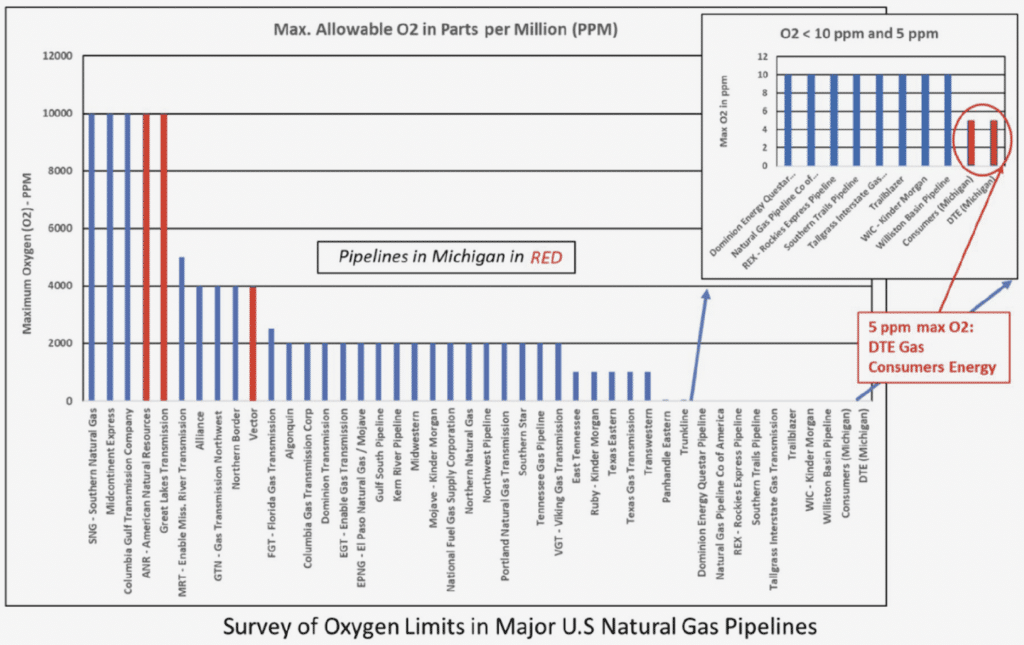
Source: Barriers to Renewable Natural Gas (RNG) in Michigan, Quantalux, January 22, 2022.