Production from oil and gas wells that target shale reservoirs typically drops by more than 50% within the first 12 months. This presents a difficult challenge for surface facility designers.
Equipment specified for the well’s initial production quickly becomes oversized, creating inefficient operations and poor return on capital. Sizing for a lower rate results in curtailment and processing inefficiencies during initial production.
Improperly sized production equipment also affects wellsite emissions, particularly those associated with vapor generated downstream of the separator.
A technical and commercial solution is needed to minimize emissions and maximize producing uptime throughout the life of the wellsite, applicable to both new and mature wells.
To address the commercial challenge, we have introduced a flexible leasing approach that facilitates rightsizing equipment as total vapor production drops, ensuring effective and economic vapor capture – at all times.
The system generates positive cash flow from the capture and sale of rich tank vapor and associated liquids that are otherwise being lost to flaring, combustion, or venting.
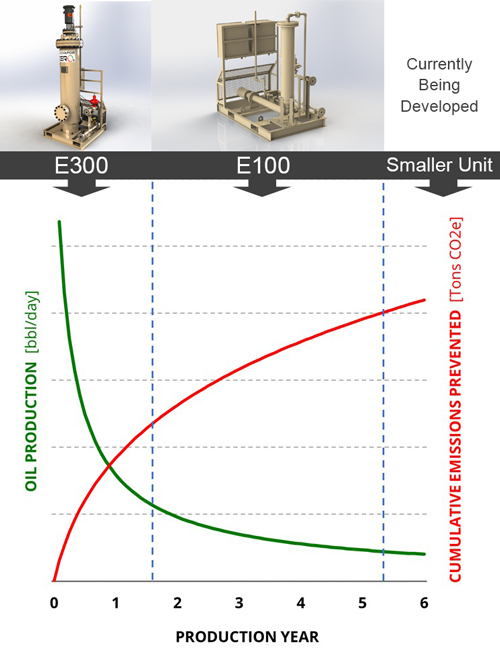
The example production profile, below, shows different models of the ZerO2 being deployed to handle the declining vapor flow rate.
Sample Production Profile and Vapor Flash Gas Recovered
ZerO2 unit is rightsized (blue dashed lines) as vapor production rate falls.
Life-of-Site Technical Solution
EcoVapor is committed to helping the oil and gas industry improve its environmental and financial sustainability by reducing flaring, minimizing emissions, and maximizing production through the application of innovative technology.
Recognizing the problem described above, we have invested significant effort to solve the vapor handling challenge posed by declining and variable rate wells, with the goal of providing full vapor capture over the life of the well pad.
We designed new models of our closed-loop ZerO2 tank vapor treatment system to handle the entire producing life of a typical asset – from 1,200 mcf/d to less than 100 mcf/d of vapor flow.
The ZerO2 recovers vapor directly from atmospheric pressure storage tanks (see schematic, below). This addresses the common problem of oxygen ingress into low pressure systems, with atmospheric storage tanks being the largest, most effective low-pressure separator on a pad (having the lowest possible operating pressure, most surface area, and highest residence time of any process equipment on site).
The closed-loop solution actively removes oxygen from vapor captured from the tanks, ensuring it meets gas pipeline specifications. This means flaring of tank vapors and flash gas becomes an exception rather than standard operating practice.
ZerO2 units operate stand-alone and therefore integrate easily with existing wellsite infrastructure, have no moving parts, and require minimal maintenance (typically just an annual catalyst replacement).


Key Takeaways
- Improperly sized production equipment leads to significant, avoidable wellsite emissions associated with vapor generated downstream of the separator.
- Ensuring appropriately sized vapor recovery equipment is in operation across the full production profile, from new to mature wells, allow operators to minimize vapor-related emissions while maximizing production and financial returns.
- Flexible commercial terms help facilitate downsizing vapor capture equipment when necessary, reducing costs to ensure continued profitable operation while minimizing vapor emissions.
- A typical Life-of-Site installation will prevent a cumulative 21,000 tons of CO2e emissions, avoiding the need to purchase at least $63,000 in carbon offset credit purchases.