Crude oil and condensate are routinely loaded into transport trucks at well sites and production pads that lack access to a liquids export pipeline.
When trucks are being loaded from the storage tanks, vapor is displaced from the trailer as it fills. This vapor is a mixture of hydrocarbon vapor – volatile organic compounds, or VOCs – and air.
In many cases, the vapor is vented directly into the atmosphere, accounting for more than 10% of total VOC emissions from a production site.
To mitigate venting, operators can pipe the displaced truck vapor back to the tank battery.
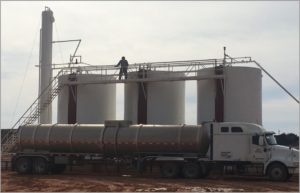
However, since the displaced vapor contains significantly more oxygen (from the entrained air) than is permitted in gas export pipelines, they have little choice but to flare the oxygen-contaminated gas.
Burning the truck loading vapor emits VOCs, nitrous oxides (NOX), and greenhouse gases.
Consequently, using combustion as a strategy for managing truck vapor emissions is also coming under greater scrutiny by stakeholders seeking to reduce or eliminate all emissions from oilfield operations.
Since tying into a liquids export pipeline is cost-prohibitive for many locations, especially those with low production rates, an alternative solution for avoiding both venting and flaring is needed.
A Simpler Alternative
Oxygen removal technology provides a simpler, cost-effective alternative to venting or flaring of tank loading vapor.
The vapor is passed through a bed of catalyst, which converts the oxygen into CO2 and water. However, unlike combustion, which releases CO2 into the atmosphere and generates other undesirable emissions, the CO2 produced by catalysis remains in the gas stream and can be handled later in the gas production process. No other byproducts are generated.
An oxygen removal system is typically installed to allow all tank vapor to be captured, treated, and sold. Including truck loading vapor is merely one valuable application of the equipment’s capabilities.
However, because oxygen removal technology can only handle up to 3.5% oxygen concentration on a continuous basis (up to 5% on an instantaneous basis), the truck vapor stream – which may contain several tens of percent oxygen – must be diluted with produced natural gas. This avoids overheating the exothermic oxygen removal system while still reducing the oxygen content to acceptable levels for the gas export pipeline.
The chart below shows reactor temperature and oxygen content data from an EcoVapor ZerO2 system in operation at a customer’s well site.
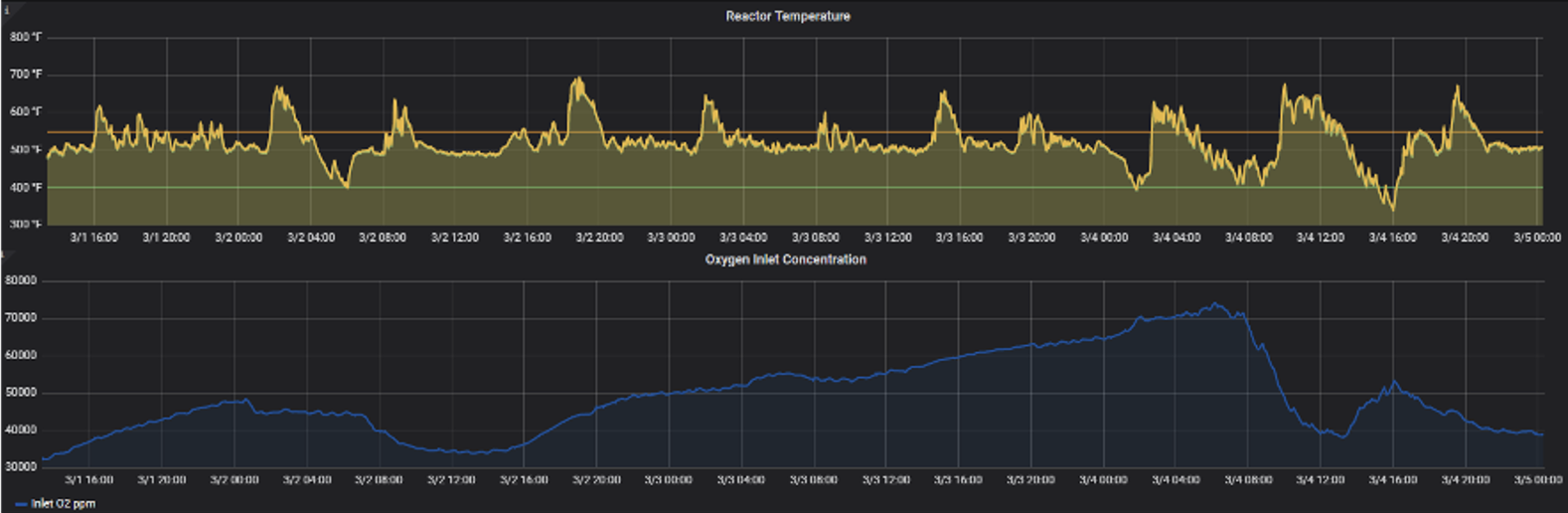
All vapor generated at the site is treated, including vapor captured during truck loading.
The baseline operating temperature of the reactor when no oxygen is present in the gas stream is approximately 500°F. Each spike above 500°F represents an offtake of crude oil. The most significant spikes occur when up to three trucks were loaded back-to-back.
The upper working temperature limit of the reactor is 750°F. This level is never reached because the oxygen content of the vapor inlet stream is continuously monitored and diluted with produced natural gas when necessary.
We are frequently asked whether introducing air into the storage tanks creates an increased risk of explosion. This is not the case. To reach the lower explosive limit of tank battery hydrocarbon vapor would require 90% air in the vapor stream, well above the levels that are experienced during truck loading.
The Benefits of Capturing and Treating Tank Vapor
The benefits of mitigating truck loadout emissions using an oxygen treatment solution include:
- Lower emissions. Significantly reduced emissions of VOC and methane during truck loadouts. When vented or flared, vapor from truck loading contributes to over 10% of the permitted tank emissions.
- Reduced flaring. Less flaring leads to lower VOC, NOX, and greenhouse gas emissions.
- Improved safety. Capturing and treating all tank vapors allows operators to actively reducing storage tank pressures and to measure and treat oxygen in the vapor stream.
To learn more, please contact us at info@ecovaporrs.com or give us a call.
We’re here to help!
About EcoVapor
EcoVapor Recovery Systems provides solutions to pressing oil and natural gas production problems. EcoVapor’s technical team has extensive expertise in vapor recovery processes, and includes world-class engineers with an innovative approach to industry challenges. In over 120 installations in all major US basins, our patented ZerO2 solution helps oil and gas producers meet their air emissions and regulatory compliance goals. EcoVapor is headquartered in Denver, Colorado and has field locations in Greeley, Colorado and Midland, Texas.
Contact
EcoVapor Recovery Systems
700 17th St., Suite 950
Denver, CO 80202
Email: Info@EcoVaporRS.com
Phone: 844-NOFLARE (844-663-5273)