
Determining the total amount of low-pressure hydrocarbon vapor can be a challenge, and is important for permitting processes, reporting potential emissions, and for sizing surface equipment such as Vapor Recovery Towers (VRT) and compressor skids (VRU). We cover the most commonly used methods to estimate vapor volumes, and provide our recommendation for optimizing both operational and economic performance of production sites and facilities.

Gas capture directly from storage using EcoVapor equipment recovered all of the site vapor, eliminating tank vapor flaring. (Permian Location).
When oil and gas is produced at the well site, the combined three-phase production stream is separated into crude oil, natural gas and water. The natural gas is typically sold into a pipeline, the crude oil or condensate is usually stored in surface tanks for future sale via tanker truck and the produced water is stored in surface tanks for future disposal.
Primary separation usually occurs at 50-100 psig. As the oil is moved into atmospheric storage tanks, its pressure drops and additional light hydrocarbons – commonly known as “flash gas” – come out of solution. This process is similar to opening a bottle of champagne on a grand scale.
Importantly, vapor accumulation in oil tanks is only part of the story. Vapor is also found in water tanks because of imperfect phase separation and liberation of gas that was dissolved in the water at high pressure. Additional vapor is generated during tank loading and unloading and whenever the ambient temperature changes.
Determining the total amount of low-pressure hydrocarbon vapor can be a challenge, but is important for permitting processes, reporting potential emissions, and for sizing surface equipment and compressor skids (VRU).
In this post, we’re going to cover:
- Commonly applied approaches to vapor volume estimation
- EcoVapor’s approach developed over several years of work in this area
- A cautionary note about production variability
COMMONLY APPLIED APPROACHES TO VAPOR VOLUME ESTIMATION
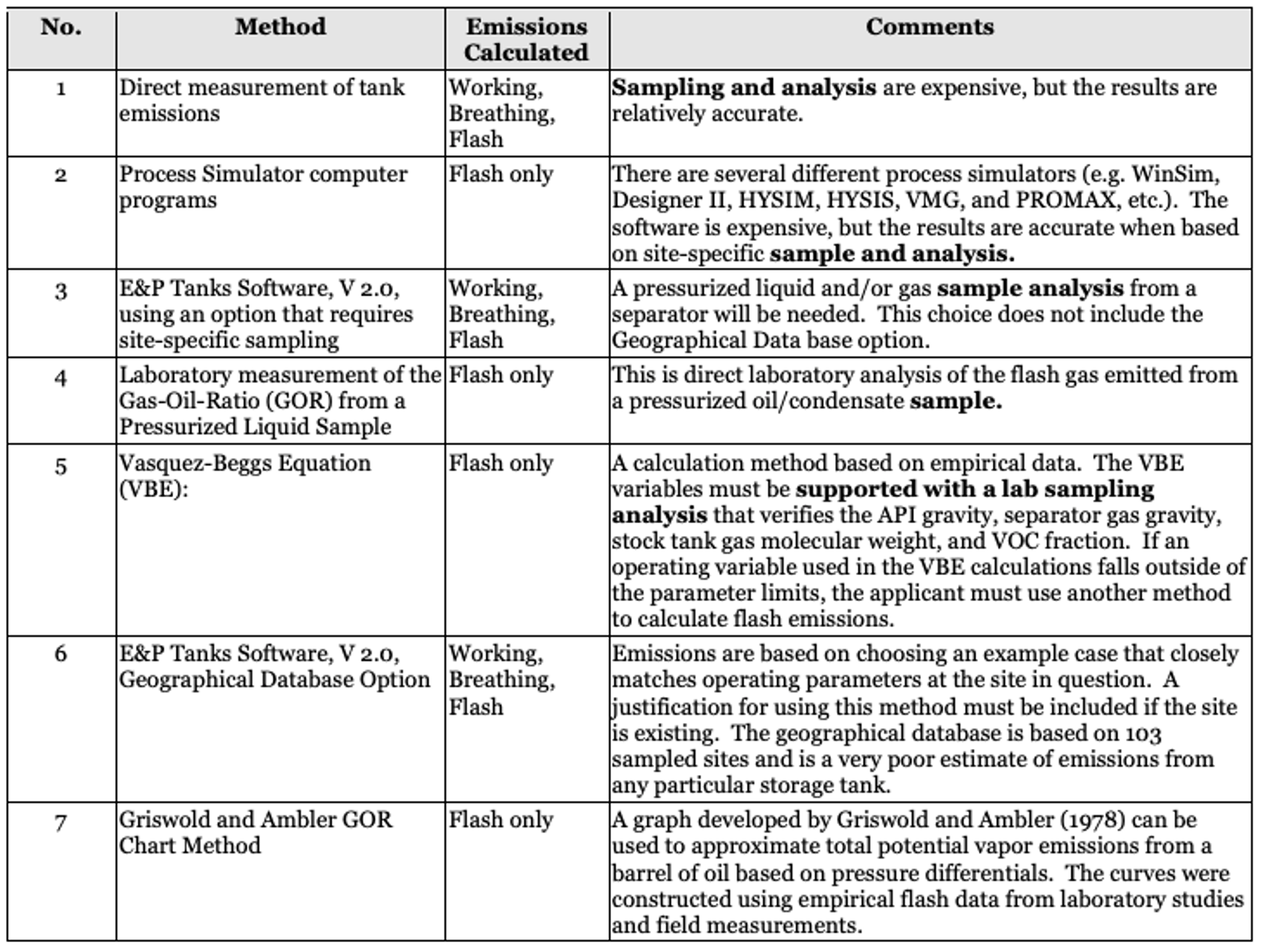
Many regulatory authorities provide options for calculating flash volume. For example, the table below show several methods recommended by the Texas Council on Environmental Quality (“TCEQ”)[1].
[1] “Calculating Volatile Organic Compounds (VOC) Flash Emissions from Crude Oil and Condensate Tanks at Oil and Gas Production Sites”, TCEQ, May 2012, APDG 5942.
The seven methods fall into three categories:
- Direct measurement
- Process simulation models, and
- Variable-based calculators.
Although TCEQ notes that process simulation models can be accurate when populated with actual sample data, as a practical matter operators most often use “representative” data rather than measured data from pressurized samples taken at the individual well site in question.
Process simulation modeling tools, such as E&P Tanks software, is no longer supported by the American Petroleum Institute as of 2018 and the VBE and Griswold methods are not particularly accurate – especially if the oil stream composition or process conditions fall outside the method’s proven range.
Let’s dive deeper into some of the options.
Direct Measurement
Direct sampling of tank vapor is possible but rarely performed, particularly at locations where multiple wells are brought on stream over time.
More frequently, operators will collect a pressurized oil sample from the separator outlet and have its composition and flash rate determined by a recognized laboratory. This method is inexpensive and provides sufficiently accurate data to model vapor production at that site.
EcoVapor offers a site assessment service that includes measuring flared volumes, tank pressures, and gas quality over a period of days or weeks to help operators understand vapor production. Data is captured using a Programmable Logic Controller (PLC) and provides accurate outputs that are valuable in designing an optimal vapor recovery solution.
Using VRT Capture
Operators often use the volume of vapor captured per barrel of oil by a Vapor Recovery Tower (VRT) from data collected at another site.
VRTs can recover well over half of the flash gas if they are sized to give adequate retention time, but do not address the other sources of low-pressure gas.
It is also common to find VRTs sized for production rates that leave them greatly undersized during flowback or for peak, flush, or slugging production rates that can overwhelm the equipment.
Across hundreds of well sites, we have observed a 30-40% increase in vapor volume recovery when recovering directly from the tank battery, which implies that VRTs capture only 60% to 70% of the total vapor in the real world. The exception is when the water to oil ratio exceeds 2:1. In this instance, facility flash volumes will likely materially exceed predictions. This case is explored later in this discussion.
It is common practice to flare the tank vapor that VRTs are unable to capture, because the tank vapor is usually contaminated with air and the presence of miniscule amounts of oxygen (i.e. 10 parts per million or less) does not meet gas export pipeline specifications.
Flaring tank vapor gas has negative financial and environmental impacts. Tank vapor gas is normally rich in C2-C7 hydrocarbons – typically 2,200 to 2,800 BTU per Standard Cubic Feet (SCF) — since most of the methane and a large portion of the ethane is recovered during primary separation, capturing and selling BTU-rich tank vapor can generate significant revenue because of the high-value Natural Gas Liquids (NGLs) content .
Process Models
Another common method for estimating tank vapor volume uses a process simulation model such as Promax or Hysys.
This is a particularly useful approach for permitting because regulatory authorities widely accept modeled data for the estimation of potential emissions.
The main limitation of process simulations is that they assume equilibrium (i.e. perfect separation) is reached at various points within the process.
We frequently find that the models predict full vapor recovery by the VRT, since separation is assumed to be 100% efficient, leaving no vapor remaining in the oil or water tanks. While this is theoretically possible, in practice it is not realistic. The gap between the simulation and observed real world behavior is rooted in the fact that phase change isn’t instantaneous for the entire stream. In an analogous scenario, it usually takes longer than snapping one’s fingers for a pot of boiling water to turn to steam, even though the entire pot is > 212 F. Champagne doesn’t stop bubbling within seconds of uncorking. The same is true for pressure-induced NGL phase changes that occur within process equipment.
Furthermore, oil typically moves downward within a VRT, but the flash vapor (i.e. bubbles that form in the oil) move upwards. If the VRT is undersized, not only is there not enough time for the NGLs to flash into vapor phase, some of the flash vapor is trapped within the liquids stream as it migrates to the tank battery, where it all comes out of solution.
Our Recommendation
EcoVapor has developed an estimation method that is sufficiently accurate for real-world applications. It involves independently calculating oil flash, water flash, and working and breathing losses.
- Oil flash estimation requires knowing the API gravity of the oil and the operating temperature and pressure of the last stage of separation before the tanks. API gravity indicates the volatility of the oil, and the other inputs quantify the change in vapor pressure. We use equations from a study by Valko and McCain, from Texas A&M University, published in 2002[2]. The study reviewed prior work on flash estimation and presented a new statistical approach to determining vapor generation.
- Flash vapor generated from produced water is a function of the effectiveness of phase separation and we are not aware of any public data on this subject. A private engineering study of well sites in the Denver-Julesburg Basin found 1 to 4 SCF of vapor evolution per barrel of water in the tanks, so that ratio is applied in our calculations.
- EcoVapor uses recommendations from API 2000, Appendix A, to estimate vapor generated by working and breathing losses. Vapor from agitation and temperature changes is estimated at 6 to 12 SCF per barrel of oil and 6 SCF per barrel of water.
[2] “Reservoir oil bubblepoint pressures revisited; solution gas-oil ratios and surface gas specific gravities”, P.P. Valko, W.D. McCain Jr., Journal of Petroleum Science and Engineering 37 (2003) 153-169.
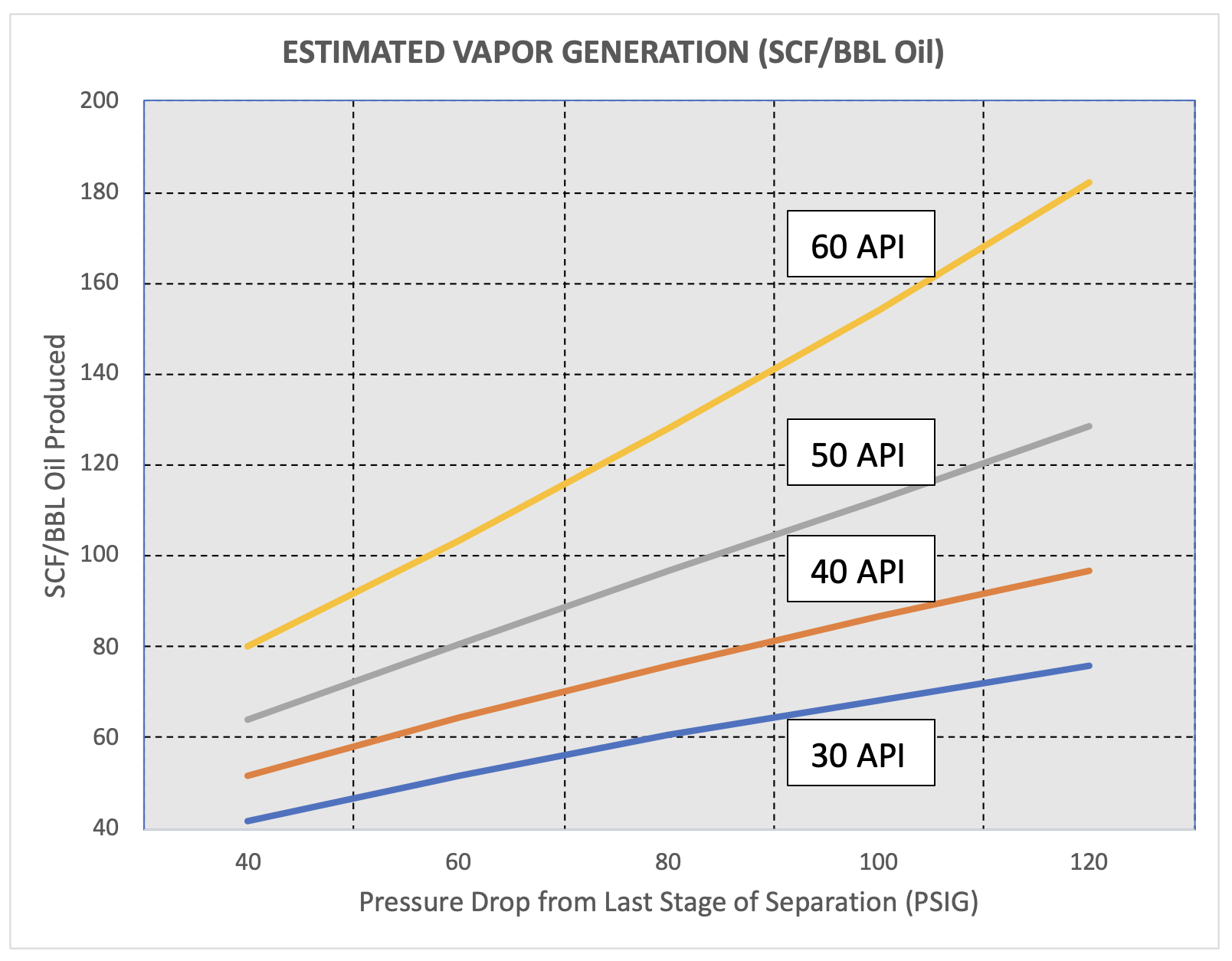
The chart below shows the estimated total vapor, in SCF, that would be generated per barrel of oil produced. That is, the total vapor is expressed in relation to oil production only.
The x-axis represents pressure drop between the last stage of separation and the storage tanks. Lower pressure drops result in less vapor generation, and higher pressure drops evolve more flash vapor from the liquids.
Values for crude oils of various API gravities are shown by the different colored lines.
The chart was generated using the following assumptions:
- Separator temperature of 110°F. Higher separator temperatures increase the bubble point at separation and result in more produced gas from the separator. The effect differs with API gravity but, in general, each 10°F change adds or subtracts 1.5 – 3.0 SCF/BBL from the values shown in the chart.
- A water-to-oil production ratio of 2:1. This is an important variable because we have observed sites where increased water production results in more vapor generation than increased oil, a result not predicted by any of the traditional estimation methods. At water ratios of 4:1 it is possible that vapor generation in the water tanks may represent one-third of total site vapor, and higher water cuts indicate the possibility of even higher vapor volume. In our method these are indicated by empirical data and are site specific. Nevertheless, higher water production typically results in unexpected vapor volume in the water tanks.
- Water flash was assumed at a median value of 2 SCF per barrel of water produced.
- Working and breathing losses were assumed to be 9 SCF per barrel of oil and 6 SCF per barrel of water.
An Important Caveat: Variability
It is standard practice to estimate production volumes in units per day despite significant observed production variability during the day – particularly with newer wells.
Changing or slugging production rates, the volume and timing of liquid dumps from separators, and the effectiveness of separation, among other causes, result in significant variations in downstream liquid and gas rates.
Multiple wells feeding the same tank battery compound these issues.
For equipment sizing, EcoVapor recommends adding at least 25% to 50% to the potential process volumes to ensure surface equipment can accommodate changing rates over relatively short periods of time.
Benefits of Accurate Vapor Measurement
The benefits of EcoVapor vapor measurement methodology include:
- Accurate estimates for air permitting, mitigating the potential risk of non-compliance.
- Right-sizing production equipment to avoid “over-treating” for peak production scenarios.
- Right-sizing production equipment to avoid under sizing for peak production rates, resulting in inadequately sized vapor recovery equipment and venting from the tank battery.
- Better ESG reporting for building confidence with the investment community and key stakeholders.
- Optimizing the profitability of operations by estimating – and capturing – valuable BTU-rich tank vapor from all sources.
EcoVapor is committed to helping oil and gas operators take steps toward a zero emissions wellsite. Contact us at info@ecovaporrs.com to learn more about how EcoVapor can help you accurately determine the amount of vapor generated at your operations and optimize operational and economic performance.
Please contact us at info@ecovaporrs.com for more information.
About EcoVapor
EcoVapor Recovery Systems provides solutions to pressing oil and natural gas production problems. EcoVapor’s technical team has extensive expertise in vapor recovery processes, and includes world-class engineers with an innovative approach to industry challenges. In over 120 installations in all major US basins, our patented ZerO2 solution helps oil and gas producers meet their air emissions and regulatory compliance goals. EcoVapor is headquartered in Denver, Colorado and has field locations in Greeley, Colorado and Midland, Texas.
Contact
Jeff Wilson
Product Management
EcoVapor Recovery Systems
700 17th St., Suite 100
Denver, CO 80202
Email: JeffWilson@EcoVaporRS.com
Direct: 405-570-6086
Office: 844-NOFLARE (844-663-5273)