Oil and gas Facilities Engineers have the difficult task of managing Lease Operating Expense (LOE) of surface production equipment as output naturally declines over time. Equipment installed for initial production (IP) flow rates can quickly become oversized as a well ages, which can affect performance and per-unit operating costs. Right-sizing facilities to simultaneously optimize production and minimize LOE as volumes decline is an ongoing challenge.
That is why EcoVapor’s ZerO2 product line offers a range of sizes to cost-effectively capture flash gas and reduce routine flaring from tank batteries. Patented ZerO2 technology removes oxygen from natural gas, allowing the flash gas volumes to be captured, purified to pipeline specifications and sold – converting a waste stream into positive returns over the life of the well.
Addressing Well Site Efficiency Through the Life of the Well
At IP, one or more ZerO2 E300 units are used to handle the large volume of tank vapors generated at new wells. As production declines, the capacity of the E300 units installed at IP eventually becomes oversized. It is at this point that we recommend replacing the E300 units with smaller E100 equipment designed to cost-efficiently treat tank vapor volumes of 100 mscfd or less, allowing the operator to reduce lease and electricity costs while maintaining the ability to eliminate routine flaring.
The Economics and Emissions of Gas Capture
The example below demonstrates the economics of reducing tank battery emissions by purifying tank vapors of oxygen to meet pipeline specification and selling the high-Btu gas.
Key assumptions:
| Scenario: | Greenfield site producing 5,100 bopd at IP with a 72% annual decline. |
| Flash Gas Volumes: | 300 Mscfd of 2,500 Btu/scf generated at IP from both oil and water tanks. |
| Gas Price: | $3.25/mmbtu, 5% hub differential and 15% burden (taxes and fees), Btu-adjusted. |
| Costs: | All vapor recovery unit (VRU) and ZerO2 installation and lease costs included in Operating Cost. |
| Carbon Credits: | Not included. |
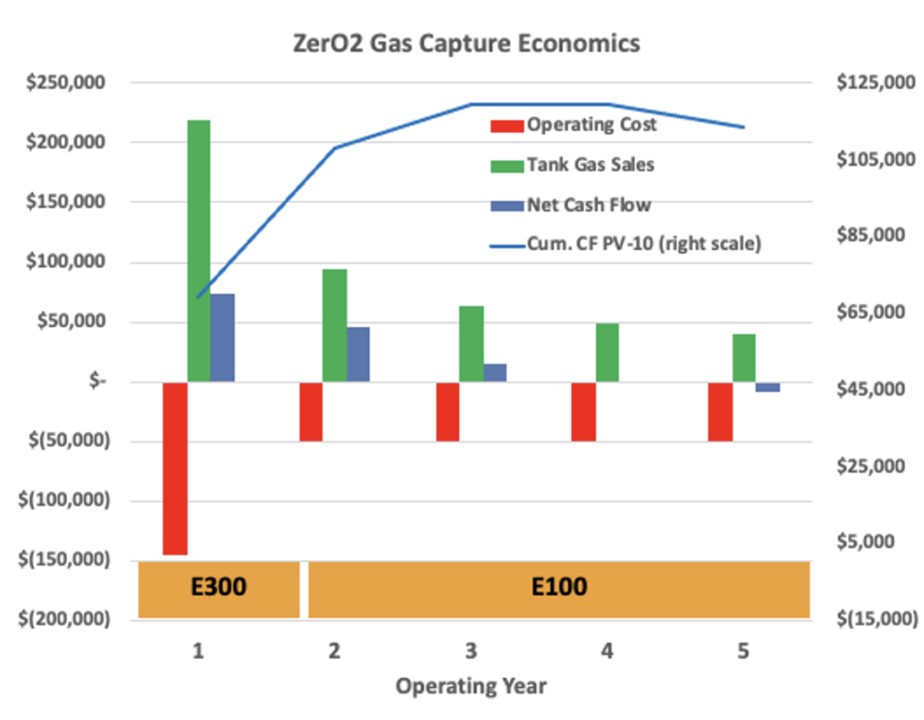
The chart shows that one E300 would be used during the first year and then replaced by a smaller E100 model for the remaining four-year period. While net cash flow is positive or neutral for the first four years, the total value of the gas capture program over the five-year period generates more than $110,000 in present value discounted at 10%. That is, the installation and lease costs of the gas capture program (i.e., the VRU and ZerO2) are more than covered in year 1 and the economics of the program remain positive throughout the life of the well.
The avoided CO2e from elimination of tank flaring is shown in the following chart based on the above example. Over the five-year period, more than 18,000 MT of CO2e is avoided.
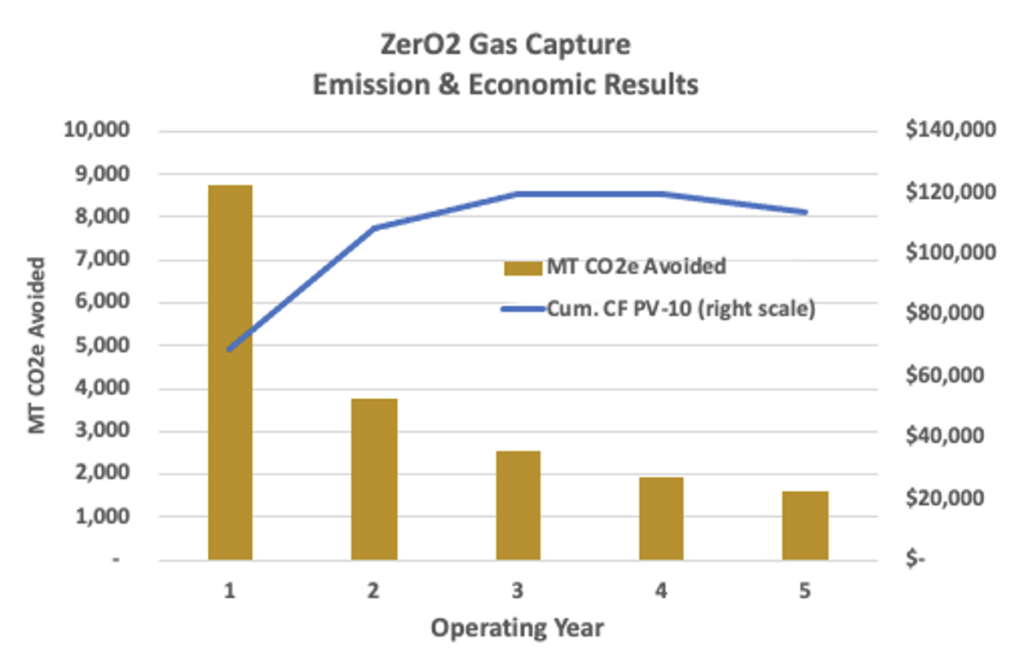
The results are an emissions reduction program that significantly reduces flaring and CO2e with positive economics over the life of the asset.
An Environmental Solution for Brownfield Sites
Importantly, the E100 is a key solution for reducing flaring and emissions at brownfield sites. There are many thousands of operating tank batteries with lower production that can benefit from the elimination of tank flaring while generating additional cash flow. Even 500 bopd can result in flash volumes of 1 MMscf per month of high-Btu gas. Since the VRU and much of the gas capture infrastructure is typically already on existing locations, the incremental cost of adding an E100 is more than offset by selling the gas that was previously flared.
Best Practices for Optimizing Gas Capture Field-Wide
The graphic below illustrates how one leading major operator sequences the field-wide exchange of multiple E300 and E100 ZerO2 units, redeploying the larger capacity equipment to new drill sites and stepping down to the E100 at more mature facilities. This practice reduces costs in equipment and the downsizing reduces LOE at older production pads. The gas capture and emission benefits are retained throughout the life of the wells, across the field.
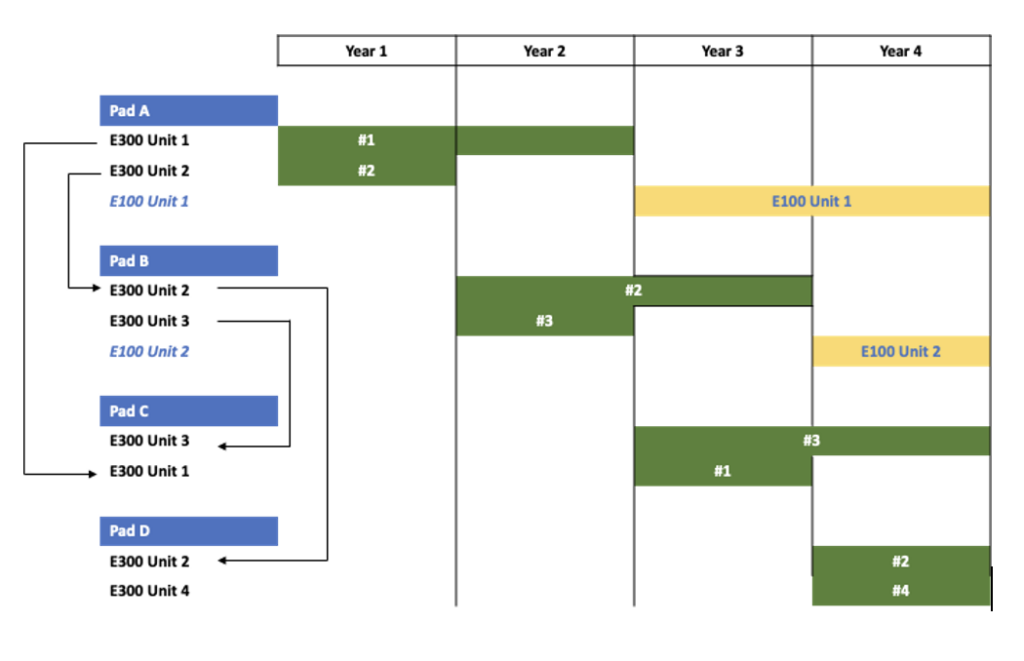
This program is financially beneficial in two ways: first, by reducing LOE by stepping down to the E100, and second, the operator can minimize the total number of units under lease by redeploying the larger units to new sites. As of September 2023, this producer operates 37 of the E300s and 40 of the E100s.
Summary
By converting a waste stream into revenue, reducing routine flaring and emissions at both new drill and brownfield sites can generate positive economics. EcoVapor has a complete lineup of solutions for reducing venting and flaring emissions from upstream tank batteries.
Contact us today to discuss how we can help you tailor a program for converting well site waste streams into revenue and achieving your environmental performance objectives.
About EcoVapor
EcoVapor, a DNOW company, offers a suite of technology-based solutions for improving the sustainability of gas-powered energy systems by converting waste streams into revenue, which reduces emissions. Our flagship ZerO2™ removes oxygen from tank vapors generated in oil and produced water tanks, allowing gas to meet pipeline specification and be sold instead of otherwise being flared. We serve both the Oil and Gas and Renewable Natural Gas (RNG) markets.
EcoVapor is headquartered in Denver, Colorado and has field locations in Greeley, Colorado, Midland, Texas, and Williston, North Dakota.
Contact
EcoVapor Recovery Systems (a DNOW Company)
Email: ecovapor.info@dnow.com
Phone: 844-NOFLARE (844-663-5273)
Sales: Joe Hedges (281-615-2072)