On March 8, 2024, the Environmental Protection Agency (EPA) published its final new regulations to 40 CFR part 60 subpart OOOOb (“quad-o” or OOOOb) in rule format in the Federal Register. OOOOb mandates significant new emissions performance standards and compliance requirements for oil and gas operators in the United States.
The table below summarizes which subparts of 40 CFR Part 60 apply to what facility type, and their effective dates.
| 40 CFR Part 60 Subpart | Facility (Source) Type | Effective Dates |
|---|---|---|
| Subpart OOOO | New, modified, or reconstructed sources | After 08/23/2011, and on or before 09/18/2015 |
| Subpart OOOOa | New, modified, or reconstructed sources | After 09/18/2015, and on or before 12/06/2022 |
| Subpart OOOOb | New, modified, or reconstructed sources | After 12/06/2022 |
| Subpart OOOOc | Existing sources | On or before 12/06/2022 |
Are My Wells and Facilities Subject to OOOOb and EG OOOOc?
Put simply, if your well site or facility has a storage tank or tank battery, most likely it is subject to the 95% reduction standard. The types of well sites and facilities, or “Sources” of emissions as the EPA calls them, include just about every type of oil and gas production operation.
| Facility Type | Description |
|---|---|
| Well Affected Facilities | Single wells drilled for oil or natural gas production |
| Compressor Affected Facilities | Single centrifugal or reciprocating compressors |
| Process Controller Affected Facilities | Collections of natural gas-driven process controllers |
| Storage Vessel Affected Facilities | Tank batteries with specified emissions potential |
| Process Unit Equipment Affected Facilities | All equipment within a process unit at an onshore natural gas processing plant |
| Sweetening Unit Affected Facilities | Units processing natural gas with subsequent sulfur recovery |
| Pump Affected Facilities | Collections of natural gas-driven pumps |
| Fugitive Emissions Components Affected Facilities | Fugitive emissions components at various facility types |
If you own or operate one of the above, then that source is subject to New Source Performance Standards (NSPS) OOOOb or Emissions Guidelines (EG) OOOOc, depending on when it was placed into service.
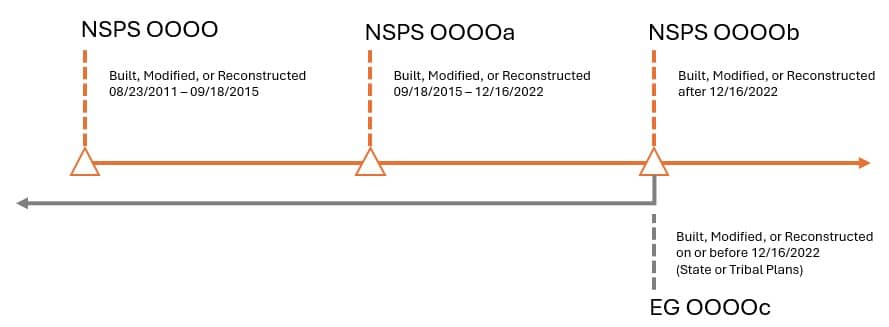
The timeline below summarizes which subparts of 40 CFR Part 60 cover what kind of facility type, based on when it was built, modified, or reconstructed.
What is EG OOOOc?
Given the many “quads” of federal regulation, a common question is – what is the difference between NSPS OOOOb and EG OOOOc?
We suggest readers keep these two things in mind:
- First, it is important to remember that OOOOb supersedes both the original OOOO and subsequent OOOOa Subparts to 40 CFR Part 60. Consequently, OOOOb effectively covers all affected sources placed into service between 08/23/2011 and 12/06/2022.
- EG OOOOc is not a regulation itself, it is a “model rule” for state agencies and tribal land administrators to use for developing updated regulations covering affected sources (facilities) placed into service both after 12/06/2022 and before 8/23/2011. Once OOOOc is in force in 2029, essentially all affected sources will be subject to updated regulations.
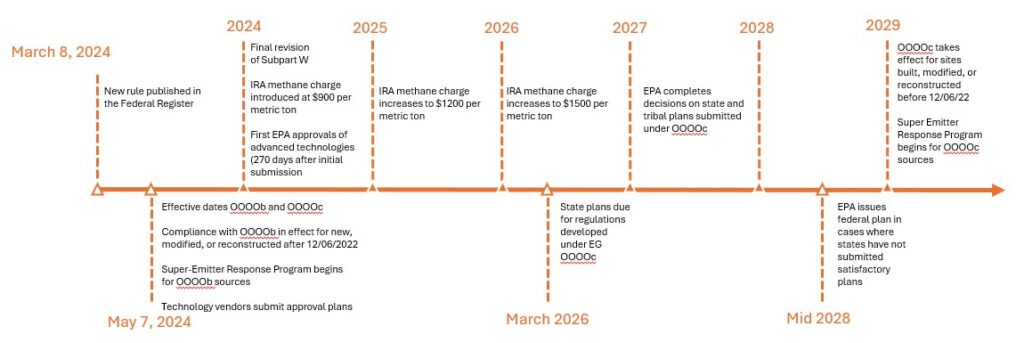
The EPA has mandated state and tribal agencies to develop their own standards within 3-5 years from when 40 CFR Part 60 was published in the Federal Register (March 8, 2024) using the model rule offered in OOOOc. States have until March 2026 to submit their plans to the EPA for approval, who will decide on approvals in 2027. In mid-2028 the EPA will issue federal plans in cases where the states did not submit a satisfactory plan or no plan at all. In all cases, OOOOc takes effect in 2029.
There is a key nuance with the development of state and tribal plans. The regulations promulgated by state and tribal agencies must be at least as restrictive as those in OOOOb, however, they can be more restrictive. We anticipate that many agencies in oil producing states will opt for emulating OOOOb, while others are likely to develop more restrictive regulations for older well sites and facilities (e.g., California, and possibly Colorado and New Mexico).
Note that even if an operator of a designated facility makes changes that meet the definition of modification after December 6, 2022, the designated facility becomes subject to subpart OOOOb of this part, and the state or Tribal plan no longer applies to that facility (Source: Page 17143 of the Federal Register/Vol. 89, No. 47/Friday, March 8, 2024/Rules and Regulations, §60.5375c).
Note that the new EPA rules (i.e., NSPS OOOOb, EG OOOOc, and Subpart W revisions) work in concert with the methane waste emissions charge (WEC) included in the Inflation Reduction Act (IRA) as part of the “whole government” approach to the new environmental regulations.
The timeline below summarizes key dates for compliance with the new rules.
Our focus in this article is on Storage Vessel Affected Facilities, which includes any individual well site or production pad with storage tanks for crude oil, condensate, and/or produced water.
The performance standard for a single Storage Vessel or Tank Battery with Potential to Emit (PTE) of 6 tons per year (tpy) or more of VOC is a 95% reduction of both VOC and methane.
The performance standard for a single Storage Vessel or Tank Battery with Potential to Emit (PTE) of 20 tpy or more of methane is a 95% reduction in methane.
Note that more complete information is available in Table 3 (NSPS OOOOb, p.16830) and Table 4 (EG OOOOc, p.16833) covering the final BSER (best system of emission regulation) and final presumptive standards for GHGs from designated facilities (Federal Register/Vol. 89, No. 47/Friday, March 8, 2024/Rules and Regulations).
EcoVapor Emissions Performance Solutions for NSPS OOOOb and EG OOOOc Compliance
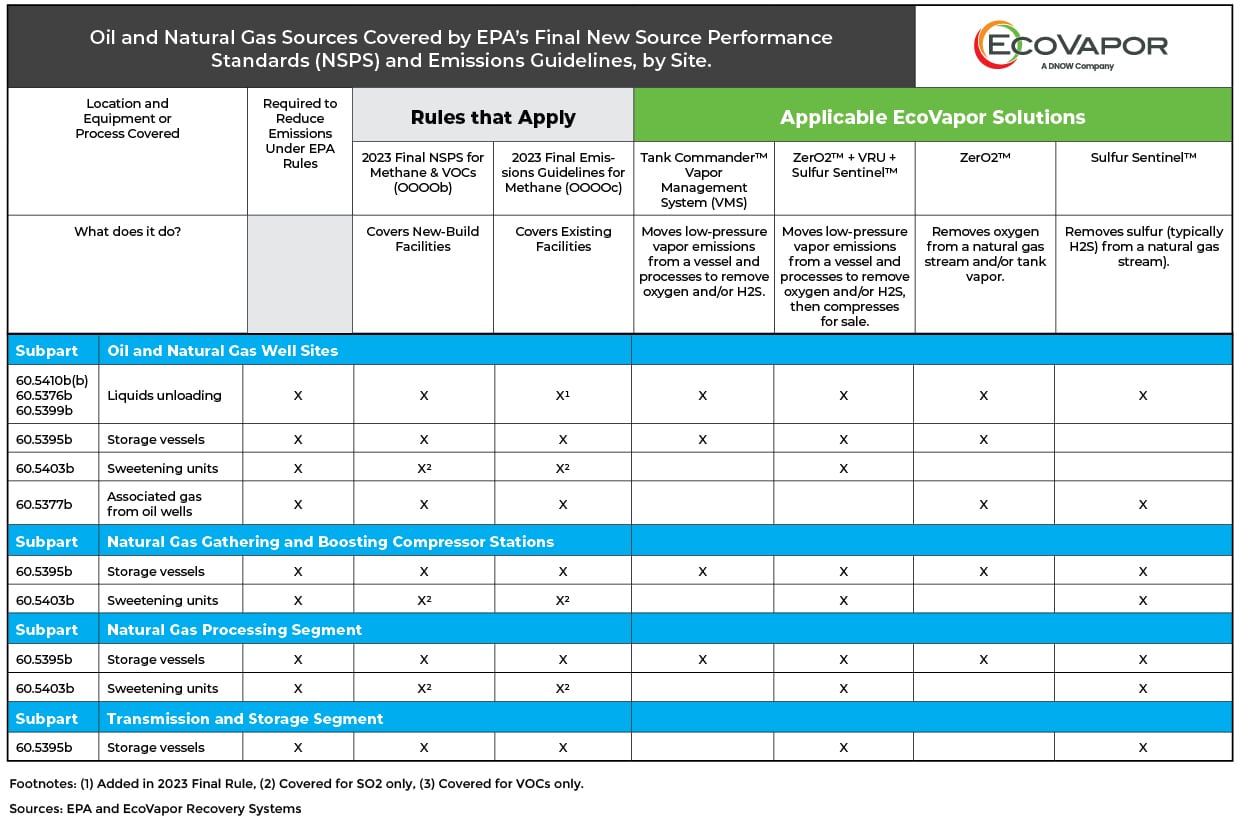
The regulation is voluminous, consisting of 408 individual pages each with three columns in small font, making it tedious and difficult to digest. One question we frequently encountered from customers was How do EcoVapor solutions help me comply with OOOOb?
We created the table below to help answer that question.
Links:
Subpart 60.5410b(b)
Subpart 60.5376b
Subpart 60.5399b
Subpart 60.5395b
Subpart 60.5430b
Subpart 60.5377b
Operators should take note that all the above sources are covered under the EPA’s new Super Emitter Program, as well, offering scrutiny from satellite and aircraft borne methane detection.
How EcoVapor Solutions Help with NSPS OOOOb and EG OOOOc Compliance
In this section, we cover how EcoVapor solutions can help you comply with the NSPS OOOOb and EG OOOOc.
Tank Commander™ Vapor Management System (VMS)
The Tank Commander VMS automatically and actively manages storage tank pressure, eliminating venting emissions. The Tank Commander VMS captures and purifies the most valuable gas stream on location – tank vapors rich in valuable NGLs – preparing it for sale.
Compliance Benefits:
- By actively managing both positive and vacuum storage tank pressures resulting from changes in temperature, pressure, and natural tank “breathing,” the potential for releasing fugitive emissions of methane and VOCs is significantly mitigated.
- Reduces and eliminates fugitive emissions that might be detected in a periodic Leak Detection and Repair (LDAR) inspection by an Optical Gas Imaging (OGI) camera.
- Significantly mitigates the risk of a third-party detecting a Super Emitter event with satellite or airborne methane monitoring and reporting it to the EPA.
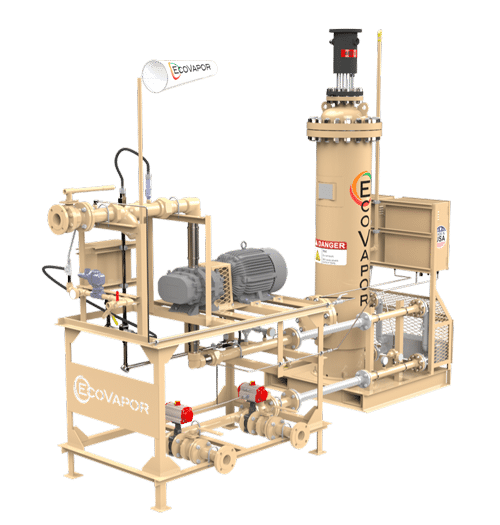
PRODUCT PAGE: Tank Commander™ Vapor Management System
READ MORE: CASE STUDY: Bison Oil & Gas Chooses Tank Commander™ Vapor Management System
ZerO2™
The ZerO2 vapor recovery system enables you to directly capture and sell 100% of your tank vapor, eliminating the need for routine tank flaring while generating more revenue.
Compliance Benefits:
- Eliminates need for routine tank flaring. Although diverting oxygen contaminated tank vapors to a control device capable of meeting the 95% destruction efficiency standard is permitted, a constantly burning tank flare still generates emissions and creates a hurdle to achieving Voluntary Emissions Reduction goals.
- Decontaminated tank vapors can also be used as fuel for onsite power generation, further reducing the emissions footprint of a well site or facility.
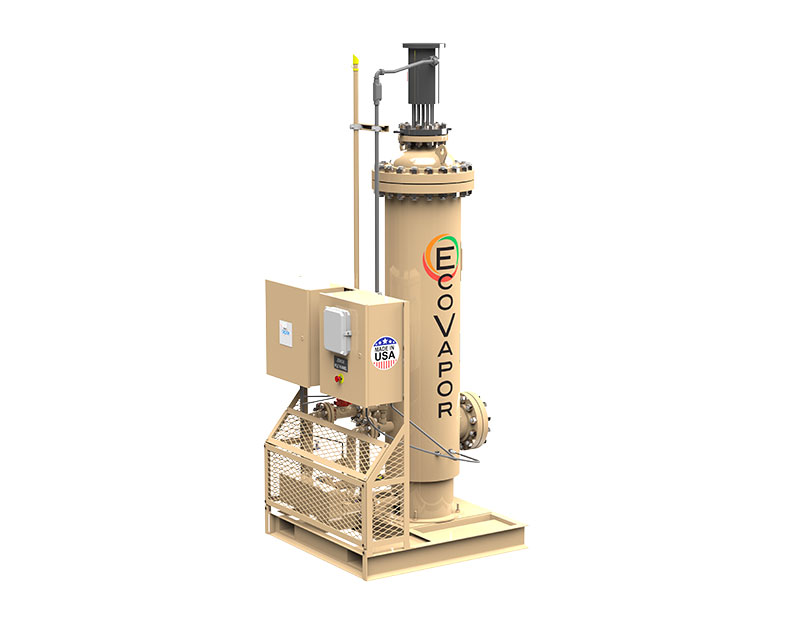
PRODUCT PAGE: Eliminate Routine Flaring with ZerO2
READ MORE: PDC Energy Case Study – Eliminating Tank Vapor Combustion Through 100% Vapor Capture
Sulfur Sentinel™
Sulfur Sentinel is an all-in-one solution for cost-effectively treating H2S at oil and gas well sites. It uses a simple but highly effective solid scavenger to safely remove hydrogen sulfide from the gas stream. This eliminates the complex equipment and scale inhibitors needed when using liquid chemicals. The spent iron oxide is easily and safely vacuumed from the vessel and disposed of in a local landfill without any special permits.
Compliance Benefits:
- Reduces H2S to pipeline specification so it can be sold instead of flared.
- Reduces routine flaring of associated gas from oil wells.

PRODUCT PAGE: H2S Treating – Sulfur Sentinel™
ZerO2 + VRU + Sulfur Sentinel
This package is used in sour gas production and helps you capture tank vapors accumulated in storage tank headspaces and decontaminate them of excessive oxygen content to meet pipeline specification, so the rich gas can be sold instead of flared.
Compliance Benefits:
- Significantly reduces the risk of a Super Emitter event.
- The Sulfur Sentinel sweetens sour gas so it can be sold instead of flared, reducing routine flaring of associated gas produced from oil wells.
- Eliminates need for routine tank flaring for reducing emissions and achieving Voluntary Emissions Reduction goals.
- Decontaminated tank vapors can also be used as fuel for onsite power generation, further reducing the emissions footprint of a well site or facility.
EcoVapor for Profitable OOOOb Compliance
You no longer have to choose between meeting environmental performance goals and generating financial results – with EcoVapor you can achieve both. As it turns out, reducing emissions not only helps with environmental regulation compliance, but it also results in stronger economic performance by capitalizing on the opportunity to capture and profitably sell tank vapors rich in valuable NGLs, instead of combusting them or inadvertently losing them as fugitive emissions.
EcoVapor solutions deliver these additional benefits:
- Converts waste gas streams and fugitive emissions into revenue.
- Reduces routine tank flaring for meeting Voluntary Emissions Reduction initiatives.
- Improves site safety profiles.
- Achieve high reliability and uptime, with no moving parts in the ZerO2, minimal preventative maintenance, and field-wide runtime >99.8%.
- Both ZerO2 and Sulfur Sentinel come in multiple sizes for right-sizing equipment and align costs with natural production declines.
- Reduce Potential to Emit (PTE) for easier permitting.
- Simplify operations (no need for a Vapor Recovery Tower).
READ MORE: Zero Routine Flaring Targets Cannot Be Met Without Addressing Tank Battery Flaring and Venting
Summary
The new NSPS OOOOb and EG OOOOc regulations are driven by the need to reduce overall emissions from the oil and gas industry. EcoVapor offers a variety of proven solutions already working for leading operators to both comply with elements of the new regulations, but also improve overall wellsite efficiency and economic performance.
Contact us today to learn more about how EcoVapor can help you achieve compliance and make money while doing it.
About EcoVapor
EcoVapor Recovery Systems, a DNOW Company, provides solutions to pressing oil and natural gas production problems. EcoVapor’s technical team has extensive expertise in vapor recovery processes, and includes world-class engineers with an innovative approach to industry challenges. In over 120 installations in all major US basins, our patented ZerO2 solution helps oil and gas producers meet their air emissions and regulatory compliance goals. EcoVapor is headquartered in Denver, Colorado and has field locations in Greeley, Colorado and Midland, Texas.
Contact
Joe Hedges
Director of Sales
EcoVapor Recovery Systems, a DNOW Company
7402 N. Elderidge Parkway, Houston, Texas 77041
E: joe.hedges@dnow.com
O: 844-NOFLARE (844-663-5273)