The potential for fires and explosions presents some of the most serious dangers to both workers and infrastructure in the Oil and Gas industry. Given that crude oil and natural gas are combustible fuels, the risk of fire and explosion is present at every point of the value chain: from upstream production operations, midstream transportation and storage, and downstream refining. As a result, mitigating this risk is critical for worker safety, infrastructure integrity, and maximizing operational efficiency.
There are several ways operators can and do reduce the risk of combustion in their operations. Typical measures include investment in costly electrical equipment rated for explosive environments to prevent ignition sources or through thorough design that minimizes the probability of combustible gas being in the wrong place at the wrong time. In this article, we focus on tank storage.
The Fire Triangle
We need to first understand the components of combustion when considering different fire risk mitigation strategies and technologies. The ‘Fire Triangle’ is a simple, yet effective model for understanding the ingredients necessary for most fires.
The Fire Triangle consists of three ingredients:
- Fuel: material that can be converted into heat energy through combustion
- Heat: provided by an ignition source to initiate the fire
- Oxygen: to create a chemical reaction with the fuel

To prevent or stop an explosion or fire, we need to “break” the Fire Triangle by removing one of the three ingredients.
Focus on Oxygen in the Fire Triangle
As fuel interacts with the oxygen around it, it generates heat, releasing gases and combustion products, such as smoke, in a process called oxidation. Oxygen is the essential catalyst in the initial ignition and ongoing burning of a fire. The most common source of oxygen is the air that forms the Earth’s atmosphere. It contains approximately 21% oxygen, more than the 16% concentration required for fire.
Liquids Storage Tanks at Risk
The use of storage tanks is routine in the Oil and Gas industry along all parts of the production, transportation, and refining process. Gravity, as it turns out, is one of the most effective natural separators given enough time. For example, just shake up a bottle of salad dressing and watch the oil rise above the water.
In a storage tank containing crude oil, produced water, gasoline or other hydrocarbon products, entrained gases that were kept in solution at higher subsurface pressures will eventually come out of solution and accumulate in the headspace (the area between the liquid surface and the tank covering.) It’s like opening a carbonated drink—once the pressure is relieved, the gas comes out of solution.
Although engineers go to school for years to learn how to build an efficient and safe facility, it is difficult to overcome physics even in the best designs. Tanks will naturally “breathe” with fluctuations in pressure. These can be caused by changes in temperature or material entering or exiting the tank(s). These pressure fluctuations can draw in atmospheric gases (i.e., air and all its constituents) through a vacuum relief when material is removed from the storage tank.
Fick’s first law of diffusion allows for another reason that air can enter a tank, even when a negative pressure gradient does not exist. The rate at which a molecule moves through a material is proportional to the concentration gradient and inversely proportional to the thickness of the membrane. This means that if pinhole sized leaks are present, or if a hatch doesn’t perfectly seal, air (and the oxygen constituent) will try to go where it is not by entering through tiny, hard to detect cracks and/or pinhole leaks. These inherent sources of air make it difficult to design and operate a true “oxygen free” facility over the many years a facility may be in operation.
Once a sufficient ratio of oxygen and hydrocarbon vapors accumulate in the tank headspace, the Fire Triangle is almost complete. With a tank full of fuel and the headspace full of combustible vapors mixed with air, a simple spark caused by static electricity, lightning, a welding torch, or other ignition source is all that’s needed to cause a serious explosion and fire.
Nearly every segment of the Oil and Gas industry uses liquids storage tanks:
- Oil and Gas Production (Upstream). Crude oil and condensate are stored in above ground storage tanks at individual well sites, tank batteries at centralized production facilities, and multi-well production pads.
- Produced Water Tanks. Produced water is stored in tanks at individual well sites, tank batteries, and Saltwater Disposal (SWD) facilities.
- Midstream Storage. Midstream companies use many tanks for storing crude oil and condensate awaiting transportation to processing plants and refineries.
- Degassing. Tank batteries are used in some applications to de-gas liquids to meet Reid Vapor Pressure specifications prior to transport in pipelines.
- Oil Refineries. Crude oil refineries use large above-ground storage tanks extensively to hold crude oil awaiting processing and finished petroleum products (e.g., gasoline, diesel, jet fuel, etc.)
- Airports and Fleet Operations. Airports use large tanks to store jet fuel and large fleet operations will routinely store gasoline and/or diesel to facilitate bulk purchases and efficient fueling practices.
Oxygen Removal – Breaking the Fire Triangle in Oil and Produced Water Storage Tanks
One of the most effective ways to break the Fire Triangle and mitigate the risk of fire and explosion is to remove oxygen from the accumulated tank vapors. Catalytic oxygen removal is a safe and effective method of deoxygenating tank vapors.
The EcoVapor ZerO2 oxygen removal system harnesses catalytic processes to safely and efficiently remove oxygen from tank vapors. Our reliable, patented technology eliminates oxygen from tank vapor gas in gas blanketing operations, significantly mitigating ignition risk in storage tanks.
READ MORE: ZerO2 Oxygen Removal Technology
ZerO2 technology uses heat from a catalytic process to safely and effectively convert oxygen into inert byproducts, including carbon dioxide. ZerO2 units have no moving parts and carry a C1D2 rating for hazardous environments.
Deployed in 13 US states and supported by EcoVapor’s Service Team the ZerO2 fleet has an impressive track record of reliability and uptime, with minimal preventative maintenance, and field-wide runtime exceeding 99.9%.
Today, the ZerO2 product lineup includes units capable of treating 20 – 2000 MSCFD that can also be deployed in parallel, providing oil and gas operators with an economically viable solution to tank flaring and oxygen removal for nearly every size of facility. The modularity of the ZerO2 enables multiple configuration types of just about any scenario.
Use Case: ZerO2 Combustion Mitigation for Oil and Gas Operator
ZerO2 technology is being used in the Oil and Gas industry specifically for mitigating combustion risk at production facilities.
The flow diagram below illustrates the configuration of a tank battery using a ZerO2 unit to deoxygenate tank vapor gas at a production facility using multiple above ground crude oil storage tanks.
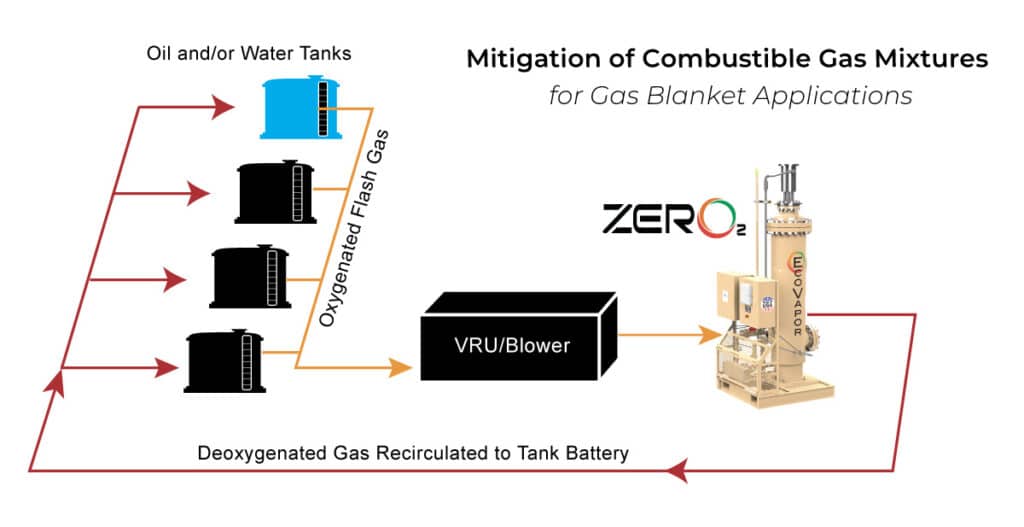
Tank vapor gas from a Vapor Recovery Unit (VRU) is routed to the ZerO2 for deoxygenation. The deoxygenated gas is routed back into the tank headspaces as an oxygen-free “gas blanket,” effectively breaking the Fire Triangle.
Benefits of ZerO2 for Fire Risk Mitigation
The benefits of using ZerO2 technology for gas blanketing applications and tank vapor recovery include:
- Break the Fire Triangle by removing oxygen from tank vapors accumulated in the tank headspace.
- Significantly mitigate the risk of explosion and fire.
- Compatible with other ignition prevention devices (e.g., lightning protection devices).
- Improved safety by actively managing tank battery pressures.
- Potentially minimize insurance costs.
- Modular design with straightforward installation for operational flexibility.
- Generate more revenue from gas and NGL sales (when a sales line is present).
- Reduce Potential to Emit (PTE) for easier permitting of facilities and emissions sources.
Summary
Catalytic oxygen removal from tank vapors is a safe and effective way to break the Fire Triangle and significantly reduce the risk of explosion and fire from enclosed liquid storage tanks at well sites, facilities, refineries and other industrial operations.
Contact us today to learn more about how EcoVapor technology can help you mitigate the risk of fire and explosion from Oil and Gas storage tanks.
About EcoVapor
EcoVapor Recovery Systems, a DNOW Company, provides solutions to the oil and gas production and renewable natural gas / biogas industries. EcoVapor’s technical team has extensive expertise in vapor recovery processes and includes world-class engineers with an innovative approach to industry challenges. In over 300 installations in all major US basins, our patented ZerO2 solution helps oil and gas producers meet their air emissions and regulatory compliance goals. EcoVapor is headquartered in Denver, Colorado and has field locations in Greeley, Colorado, Roosevelt, UT, Williston, North Dakota, and Midland, Texas
Contact
Joe Hedges
Director of Sales
EcoVapor Recovery Systems, a DNOW Company
7402 N. Elderidge Parkway, Houston, Texas 77041
E: joe.hedges@dnow.com
O: 844-NOFLARE (844-663-5273)