Tank Batteries are A Major Contributor to Site Emissions
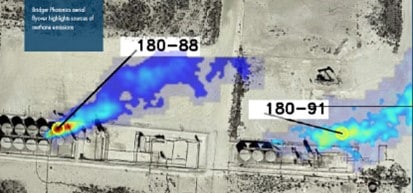
Evidence indicates that tank batteries are one of the largest, if not the largest, source of emissions of CO2, volatile organics (VOCs) and nitrous oxides (NOx) in the upstream sector. This finding was discussed fully in our 2022 webinar, “The Road to Net Zero Goes Through Your Tanks”. While emission factors are widely used by regulators and industry, direct measurement by several independent parties have shown that tank batteries account for 40% to 60% of site emissions rather than the 12% estimated by the U.S. EPA. The results are summarized in the following chart:

Key Takeaways:
- Tank batteries and compressors contribute much higher to site emissions than previously thought, and pneumatics and fugitive emissions much less.
- Direct measurement also revealed that emissions from tank batteries are not correlated to production rate, and that even low production facilities can be an issue.
Clearly, tanks must be addressed in any environmental improvement plan and particularly company commitments to net zero emissions.
In this article, we cover the two primary factors causing tank battery emissions and offer a solution that not only reduces emissions, but also generates additional revenue.
PROBLEM No. 1 – VENTING
Oil and water storage tanks operate at near-atmospheric pressures in the headspace of the tank, typically limited to 8 to 12 oz/in2 (less than one atmosphere) before pressure relief valves and/or tank gauging hatches are actuated, releasing vapors to the atmosphere. At most locations tank pressures are not controlled or actively managed but rather serve as a “buffer” between operations upstream and downstream of the battery.
Upstream factors affecting tank pressure include:
- variability in oil and water production rates
- tank battery capacity
- production methods (e.g., plunger lift)
- separator efficiency & dump valves
- API gravity of the oil
- insufficient vapor recovery tower capacity or overpressure
- changing ambient temperatures
Routine truck loading of crude oil and produced water can also create a relatively rapid change in tank pressure in states that require a closed-loop system (e.g., Colorado, New Mexico). Changing ambient temperatures cause the vapor in the headspace to shrink or expand and affect internal tank pressures. Vented emissions are mostly VOCs, water vapor, and even hydrogen sulfide in some locations.
Downstream factors include:
- tank gas quality
- compressor (vapor recovery unit, or VRU) uptime
- the efficacy of flares
This last factor is highly influenced by flare capacity and design, pipe size, pressure drop, and distance (see our article on Flare Destructive Efficiency). The very low tank pressures compared to atmosphere make oxygen ingress a common occurrence and the gas quality unfit for sale. Compressor uptime has a direct bearing on gas capture rates, matching flare capability to varying conditions can be problematic. Flared emissions are principally CO2 and NOx with smaller volumes of VOCs.
In this dynamic environment tanks have difficulty responding effectively to the multiple factors influencing tank pressures. Rising pressure can lead to venting, and falling pressure can lead to actuation of the vacuum relief and introducing air into the headspace of the tanks. Oxygen is a contaminant and most gathering pipelines limit O2 concentrations below 10 ppm.
PROBLEM No. 2 – FLARING
Flaring of tank gas is a common practice in producing oilfields where the value of the oil product is significantly greater than the value of the gas. Nevertheless, flaring is a waste of an energy resource, and the combustion products contribute to greenhouse gases in the form of CO2 and the formation of ozone with NOx.
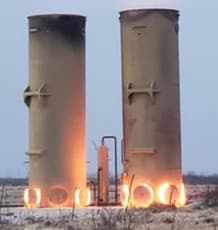
With the advent of the federal Clean Air Act regulations for the oil and gas industry (40 CFR Part 60, Subpart OOOO), many operators have adopted vapor recovery towers (VRTs) to capture a portion of the vapor that evolves with lower pressure (“flash gas”). Field observations at many EcoVapor field installations have found that VRTs, however, typically only capture 60-70% of the tank gas. The remainder includes oil flash from storage tanks, vapor in the produced water tanks, and vapors from truck loading (if applicable). This additional gas volume is normally flared.
VRTs are low pressure vessels located downstream of separation but prior to tank storage to avoid the higher risk of oxygen contamination in the tanks. Some operators have attempted to manage this risk using gas “blankets” that maintain higher pressure in the tanks using produced gas from separation. Based on discussions with numerous operators, conventional gas blankets have often proven to be problematic and not particularly effective, and the higher pressure can exacerbate the problem of venting. Gas that does not meet pipeline specifications for oxygen is flared.
THE SOLUTION
Instead of the conventional practice of treating these issues piecemeal, we recommend a comprehensive solution for continually and dynamically managing tank battery pressures and provides full gas capture from the site. This solution would significantly reduce, if not eliminate, tank flaring and venting by capture of all flash gas directly from the atmospheric storage tanks and treating for contaminants so the high-BTU content vapor can be sold instead of flared.
We designed the Tank Commander Vapor Management System with these objectives in mind. The product minimizes normal venting and flaring with minimal additional equipment. Of course, pressure reliefs and flares are still required for emergency or upset conditions to protect personnel and assets.
TANK COMMANDER™ VMS
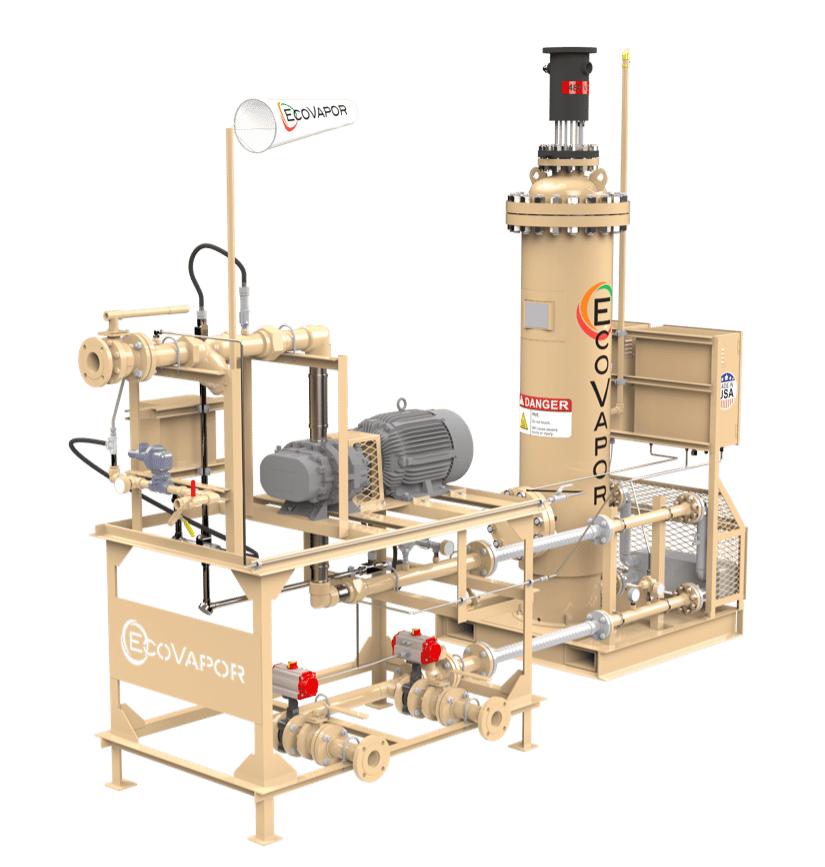
EcoVapor’s Tank Commander VMS is a complete skid-mounted solution for automatic, active tank pressure management. It can directly capture 100% of tank vapor while simultaneously eliminating tank vent emissions, maximizing the value of your oil and gas producing assets.
Some of the key operating features include:
- Continual tank pressure measurement and recording
- Vacuum and overpressure control using a combination of makeup gas and a variable drive blower – tank pressures remain between low and high set points established by the operator
- Additional VRU / compression is not required
- All gas from the tanks is treated to meet pipeline O2 specifications
- Captured and treated gas moves to the suction inlet of existing compression
- PLC control of both tank and treating systems
- Communication protocols for live monitoring and data recording
With tank pressure dynamically controlled by the Tank Commander VMS, the risk of venting is substantially reduced, and the gas quality conforms to pipeline specifications.
Case Study Spotlight – DJ Basin
A large operator in the DJ Basin in Colorado recently installed a Tank Commander VMS unit at a location already equipped with VRTs. Sensors on the Tank Commander VMS indicated the unit captured approximately 100 mscfd of additional gas was recovered from the tanks, avoiding an estimated 83 tpy of VOC and NOx and 4,900 metric tonnes of CO2e with the reduction in flaring.
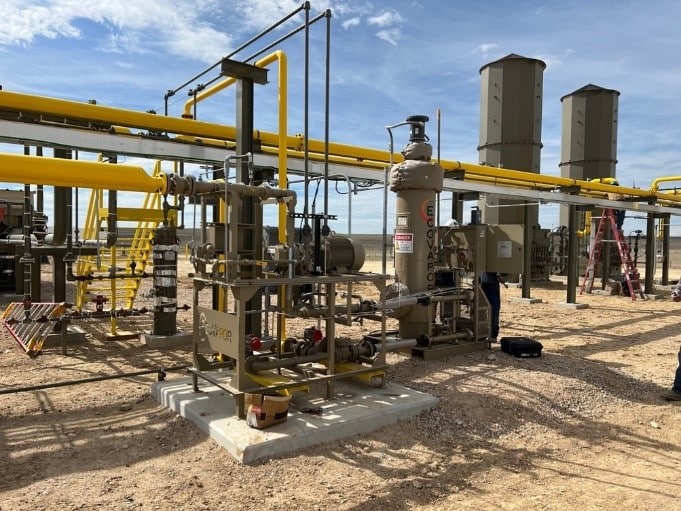
The economics of the solution are, of course, highly dependent on gas volumes and realizations, but assuming a $2.00/mcf net realization with a 2x BTU premium, this DJ Basin operator is generating over $12,000 in additional monthly revenue, which more than covers the VMS lease and operating costs.
One of the additional benefits stemming from the data measurement and reporting feature is the ability of an operator to demonstrate that venting is only by exception. Flared activity can also be measured with the addition of volume measurement on the flare line. This data could be extremely beneficial with regulatory authorities and in demonstrating continuous environmental improvement towards ESG goals (e.g., a requirement of the New Mexico Ozone Precursor Rule).
Summary
The solution to reducing harmful venting and flaring emissions while generating additional revenue is full gas capture downstream of separation. The automated, active tank battery management capability of the Tank Commander VMS does just that; providing operators the ability to address emissions from the tank battery and tank flares and generate additional revenue from the high-Btu gas.
About EcoVapor
EcoVapor, a DNOW company, provides gas treating solutions to both geologic and biogas production problems. Our fleet of proprietary ZerO2 oxygen removal (deoxo) units has grown to a fleet of nearly 300 since 2010, operating reliably for leading producers in all major U.S. basins. ZerO2 technology helps Oil & Gas and biogas producers convert waste gas streams into revenue by treating gas to meet pipeline specifications so it can be sold instead of vented or flared, generating incremental value while reducing emissions and improving environmental performance.
EcoVapor is headquartered in Denver, Colorado and has field locations in Greeley, Colorado and Midland, Texas.
Contact
EcoVapor Recovery Systems (a DNOW Company)
Email: ecovapor.info@dnow.com
Phone: 844-NOFLARE (844-663-5273)
Sales: Joe Hedges (281-615-2072)