Oil and gas operators today are faced with the multiple challenges of increasing production efficiently and maximizing profitability while also maintaining compliance with increasingly stringent emissions regulations. Flaring of both associated natural gas and tank vapors may be necessary, yet wasteful practices. While essential for safety and regulatory compliance, flaring results in the loss of valuable natural gas—an asset that could otherwise generate revenue. Several oil producing state governments, including Colorado, New Mexico, and North Dakota, have mandated regulations aimed at increasing gas capture rates and/or eliminating flaring except in emergency situations.
The good news is that advancements in vapor recovery technology allow operators to capture gas that would otherwise be flared and generate emissions and instead turn them into incremental earnings.
This blog explores the causes of flaring, the challenges it presents, and how oil and gas operators can increase profitability by converting emissions into a revenue stream while avoiding potential fines and regulatory actions.
Causes of and Reasons for Tank Flaring
Flaring of associated gas and tank vapors is performed primarily for safety reasons, operational requirements, and regulatory compliance. While necessary in certain situations, it often results in wasted resources that could be otherwise monetized for enhancing ROI.
Infrastructure Challenges
-
- Off-Spec Gas: Gas that does not meet pipeline specifications due to contaminants (e.g., oxygen, H2S) must be flared because when combined with water vapor under pressure in a pipeline it is highly corrosive and can cause pipeline failures. High oxygen content can also interfere with gas processing plant operations.
- Lack of Infrastructure: In remote areas where pipelines are not yet installed, flaring is used to dispose of stranded gas.
Emissions Regulation Compliance
-
- Regulatory Compliance: New federal and state regulations, such as EPA OOOOb, mandate a 95% reduction in emissions. Flaring is permitted under these regulations if flares achieve the required destruction efficiency.
LEARN MORE: Living with OOOOb Webinar – Strategies and Solutions for Compliance
-
- State-Specific Restrictions: Some states have taken aggressive steps to curb flaring:
-
- North Dakota: NDIC Order 24665 requires 91% gas capture, otherwise oil production can be restricted and fines may be imposed, subject to certain exemptions.
- New Mexico: In 2021, the New Mexico Oil Conservation Commission required upstream and midstream operators to reduce gas flaring and venting by 98% by 2026.
- Colorado: The Colorado Oil and Gas Conservation Commission’s Rule 912, among other things, bans routine flaring and venting and the release of raw gas, requiring 100% gas capture subject to certain provisions for emergency flaring.
-
- State-Specific Restrictions: Some states have taken aggressive steps to curb flaring:
Safety Considerations
-
- Disposal of Sour Gas: Sour gas, which contains hydrogen sulfide (H2S), is both toxic and corrosive. Flaring helps eliminate it, but the byproduct of combusting sour gas, Sulfur Dioxide (SO2), contributes to the creation of acid rain.
- Operational Upsets: In case of equipment failures or unexpected surges in gas production, flaring prevents hazardous pressure buildups.
- Preventing Combustion Hazards: Gas accumulation on-site poses a significant risk; flaring ensures volatile gases do not lead to dangerous explosions.

Caption: Cutaway of a natural gas pipeline showing the effects of internal corrosion.
The Value of Tank Vapor Recovery
Tank vapors rich in heavy hydrocarbons often represent the most valuable gas on-site due to their high BTU and NGL content. However, high oxygen (O2) levels in tank vapors can exceed pipeline specifications, leading to required flaring for both pipeline safety and avoiding the venting raw gas. Excessive O2 causes pipeline corrosion and processing issues, making it crucial to find effective solutions. As it turns out, mitigating and even eliminating tank flaring is one of the easier challenges to overcome.
The table below summarizes the economic value of full gas recovery (utilizing a VRU combined with a ZerO2), as compared to no recovery (flaring or combusting the excess gas) and partial recovery (utilizing a VRT and VRU) over a 12-month period.
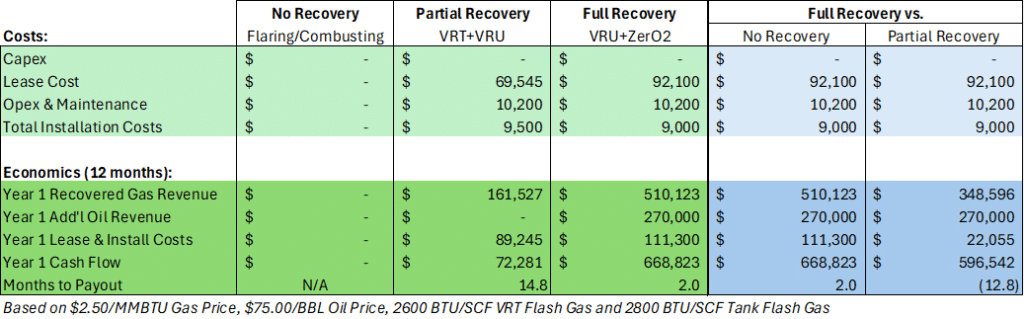
- Compared to flaring or combusting (no recovery), Full Recovery generated $510,123 and $270,000 in additional gas and oil revenue, respectively with a payout period of only 2.0 months.
- Compared to partial recovery, Full Recovery generated $348,596 and $270,000 in additional gas and oil revenue, respectively with a negative, or nearly immediate, payout.
If an operator is producing from more than one well site, these results can quickly add up to some very large numbers.
Solutions for Tank Flaring – Vapor Recovery
Upon receiving a super-emitter notification, operators must investigate the event within five days and submit a report within 15 days. The report should include a plan to resolve the issue, with a timeline for completion, a review of maintenance activities, and monitoring data from control devices. It must also assess past fugitive emissions surveys and data from continuous monitoring systems.
Additionally, operators are required to screen the entire facility—including well sites, compressor stations, and production facilities—using methods like OGI, EPA Method 21, or an approved alternative. A follow-up report must be submitted within five days of the event’s resolution, noting the date and time it ended.
Tank Vapor Sources
- Crude Oil Storage Tanks: Emit significant volumes of vapors rich in valuable hydrocarbons.
- Produced Water Storage Tanks: Contain lighter hydrocarbons that can be captured and sold rather than flared.
- Eliminates tank vapors and associated flaring.
- Consolidates production equipment into a single streamlined system.
- Retrofitting can be costly.
- Increased operational complexity.
- Backup storage requirements increase capital expenditures.
- Produced water tanks are usually still required, creating the potential for tank flaring.
- Revenue Generation: Convert emissions into profits by capturing and selling valuable, BTU-rich tank vapor gas instead of burning it. Tank vapor can contain up to 20 GPM of NGLs, making it the most valuable MCFs on site.
- Elimination of Tank Flaring: Significantly reduce or even eliminate tank flaring.
- High Reliability: Over 98% uptime ensures continuous operation.
- Effective Gas Processing: Discharged gas meets even the strictest pipeline requirements for oxygen.
- Seamless Integration: Works within existing infrastructure; modular design allows for scalability.
- None identified—ZerO2 provides a cost-effective, efficient, and reliable solution.
Summary
Flaring tank vapors while necessary for safety reasons ultimately represents a loss of valuable resources and revenue. By adopting technologies that maximize vapor recovery, like ZerO2, oil and gas operators can eliminate tank flaring, comply with stringent regulations, and convert emissions into earnings. As state and federal requirements become more rigorous, investing in gas capture solutions is not just a compliance issue—it’s a smart business decision.
Contact us today to learn more about how EcoVapor can help you stop burning profits by converting emissions into earnings.
About EcoVapor
EcoVapor Recovery Systems, a DNOW Company, provides solutions to pressing oil and natural gas production problems. EcoVapor’s technical team has extensive expertise in vapor recovery processes, and includes world-class engineers with an innovative approach to industry challenges. In over 120 installations in all major US basins, our patented ZerO2 solution helps oil and gas producers meet their air emissions and regulatory compliance goals. EcoVapor is headquartered in Denver, Colorado and has field locations in Greeley, Colorado and Midland, Texas.
Contact
Joe Hedges
Director of Sales
EcoVapor Recovery Systems, a DNOW Company
7402 N. Elderidge Parkway, Houston, Texas 77041
E: joe.hedges@dnow.com
O: 844-NOFLARE (844-663-5273)