Renewable natural gas (RNG) is pipeline quality gas manufactured from the decomposition of organic matter, otherwise known as biogas.
Access to a consistent supply of biogas is essential to a successful RNG effort, so where does biogas come from?
In this article, we cover the most common sources of biogas.
RNG Feedstocks
The Environmental Protection Agency (EPA) notes that “The biogas used to produce RNG comes from a variety of sources, including municipal solid waste landfills, digesters at water resource recovery facilities (wastewater treatment plants), livestock farms, food production facilities and organic waste management operations.”
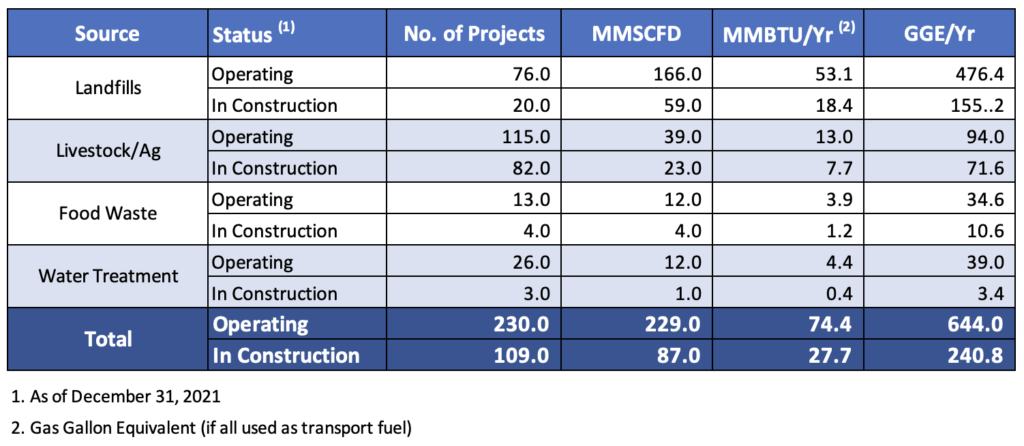
The table below shows the status and contribution of RNG projects in the U.S. as of the end of 2021.
 Source:
 Landfills. Landfills represent that largest RNG feedstock at an estimated 166 million standard cubic feet per day (MMSCFD) of biogas. Decomposing trash and foodstuffs in landfills provide a relatively constant supply of methane.
Livestock / Agriculture. According to the EPA, anaerobic digesters work best at farms that collect large amounts of manure as a liquid or slurry on a daily basis. These operations provide the second largest feedstock of biogas.
Food Waste. Because food waste contains primarily organic matter, it is considered a high-value source of biogas. Food waste is easily available, contains significant organic content and highly suitable for anaerobic digestion.
Water Treatment. Wastewater treatment plants generate biogas as organic matter decomposes. Technologies exist for digesting the sludge to both reduce its volume and to produce biogas.
In our article Biogas to RNG – Upgrading to Renewable Natural Gas to Meet Specs, we cover the RNG market in more detail and discuss the EcoVapor solution for upgrading biogas to RNG.
About EcoVapor
EcoVapor Recovery Systems provides solutions to pressing oil and natural gas production problems. EcoVapor’s technical team has extensive expertise in vapor recovery processes and includes world-class engineers with an innovative approach to industry challenges. In over 120 installations in all major US basins, our patented ZerO2 solution helps oil and gas producers meet their air emissions and regulatory compliance goals. EcoVapor is headquartered in Denver, Colorado and has field locations in Greeley, Colorado and Midland, Texas.
Contact
EcoVapor Recovery Systems
1422 Delgany Street, Suite 100
Denver, CO 80202
Email: Info@EcoVaporRS.com
Phone: 844-NOFLARE (844-663-5273)