In our article Living with OOOOb – Strategies and Solutions for Compliance we covered the major components of the Environmental Protection Agency’s (EPA) comprehensive updates to 40 CFR Part 60 Subpart OOOOb (NSPS OOOOb) and Emissions Guidelines OOOOc (EG OOOOc), and how EcoVapor solutions can help operators achieve compliance.
In that blog post, we noted that all the emissions sources described in that blog (i.e., oil and gas well sites, storage vessels, natural gas gathering and boosting compressor stations, SWD facilities and others) are covered under the EPA’s new Super Emitter Program.
In this article we drill down deeper into the major components of the Super-Emitter Response Program that was published in the Federal Register on March 8, 2024, and how EcoVapor solutions can help operators keep a low emissions profile and profitably avoid the risks of being identified as a “Super Emitter.”
Purpose of the Super Emitter Response Program
One of the more controversial elements of the Environmental Protection Agency’s (EPA) comprehensive updates to NSPS OOOOb and EG OOOOc, is the Super-Emitter Response Program (SERP), which allows non-governmental actors (read: activists) the ability to scrutinize and report on emissions releases at oil and gas operations.
The Super Emitter Response Program was established in response to the EPA’s recognition that the top 5% of emissions sources account for over 50% of total emissions in the oil and gas industry. This insight, supported in part by research from Adam Brandt et.al. in 2016, highlights a key finding: a small number of “super-emitters” are responsible for the vast majority of emissions. Other credible studies consistently demonstrate that these super-emitter events are primarily driven by equipment malfunctions or adverse operating conditions (e.g., freezing weather), underscoring the need for targeted interventions to address the largest sources of emissions.
The EPA defines a Super-Emitter Events as one having a quantified emission rate of 100 kilogram per hour (kg/hr) of methane or greater, which is equivalent to 129 mscfd.
The Super Emitter Response Program sets up a system for quick notifications about super-emitter emissions events, allowing them to be addressed promptly and efficiently. The objective is to put greater focus on the events responsible for large emissions events to make a significant impact on reducing overall emissions of greenhouse gases.
Final Rule Eliminates Civilian Notification
One controversial aspect of the Super-Emitter Response Program as it was originally proposed was allowing private organizations to independently monitor and report super-emitter events directly to operators and the EPA.
Ostensibly, due to concerns over lengthy court battles challenging the legality of involving non-governmental organizations in emissions enforcement, the EPA revised the rule. In the final rule, the EPA designates itself, not third parties, as having the responsibility for notifying operators of super-emitter events, after reviewing third-party reports. Operators must then investigate and report their findings to the EPA.
One of the major concerns voiced during the rulemaking process was the prospect of unauthorized individuals accessing oil and gas well sites and facilities to identify emissions events, potentially placing untrained monitors in dangerous operational environments. In response, the EPA clarified that certified third parties can only use remote sensing technologies, such as satellites or aerial surveys, and are prohibited from accessing oil and gas sites or using close-proximity technologies like optical gas imaging (OGI) cameras.
LEARN MORE: EPA Super Emitter Program Webinar
You Received a Super-Emitter Notice – Now What?
Upon receiving a super-emitter notification, operators must investigate the event within five days and submit a report within 15 days. The report should include a plan to resolve the issue, with a timeline for completion, a review of maintenance activities, and monitoring data from control devices. It must also assess past fugitive emissions surveys and data from continuous monitoring systems.
Additionally, operators are required to screen the entire facility—including well sites, compressor stations, and production facilities—using methods like OGI, EPA Method 21, or an approved alternative. A follow-up report must be submitted within five days of the event’s resolution, noting the date and time it ended.
6 Major Risks of Super-Emitter Events
Operators face several obvious and not-so-obvious risks from their operations being identified as the source of a super-emitter event, including:
- Environmental and Climate Impact
- Methane as a Potent Greenhouse Gas: Methane is believed to be more than 28 times more potent of a greenhouse gas than carbon dioxide according to the EPA, making it a powerful contributor to global warming. A super-emitter event can rapidly escalate an oil and gas operator’s emissions footprint, negatively impacting air quality and corporate reputation.
- Financial Risks
- Fines and Penalties: A super-emitter event can result in enforcement actions and hefty fines for methane leaks and non-compliance with emissions standards. The new Waste Emissions Charge may also come into effect. LEARN MORE: EPA Waste Emissions Charge
- Increased Operational Costs: Mitigating a super-emitter event requires emergency interventions, repairs, and, in many cases, upgrades to equipment and processes to prevent future occurrences.
- Market Impact and Investor Scrutiny: A super-emitter event can negatively impact corporate reputation with the investment community, impacting access to capital and its cost. Energy companies with poor environmental practices may find it harder to attract investment.
- Reputational Damage
- Public Relations and Brand Impact: A super-emitter event can damage your corporate reputation with the public and regulators, which can lead to public backlash and greater regulatory scrutiny.
- Activist Pressure: Environmental advocacy groups may use super-emitter events to amplify calls for more stringent regulation, advocate divestment from fossil fuels, and even lobby for punitive enforcement actions against the company.
- Operational Disruptions
- Shutdowns and Delays: Detecting, mitigating, and repairing the sources of super-emitter events may require costly and disruptive operational shutdowns or delays, leading to lower production and cash flow.
- Health and Safety Risks
- Safety Hazards for Workers: Fugitive emissions of methane and VOCs released during super-emitter events can pose a health hazard to workers, particularly in confined spaces.
- Community Health Impact: In cases where leaks are substantial or prolonged, people in nearby communities can experience health risks such as respiratory problems.
- Legal Liabilities
- Lawsuits: Super-emitter events can expose oil and gas operators to lawsuits from environmental groups, governments, or even local communities negatively impacted by the emissions.
- Compliance Violations: Non-compliance with permitted emission standards can result in expensive lawsuits and liabilities.
Taking Command of Tank Battery Emissions and Mitigating Super-Emitter Events
Tank batteries have emerged as one of the largest sources of well site and facility emissions, a subject we covered in our webinar The Road to Net Zero Runs Through Your Tanks. Eliminating flaring of tank vapors can have a significant impact on reducing NOx emissions, which is critical in EPA designated non-attainment areas, however, tank venting remains a material cause of methane and VOC emissions.
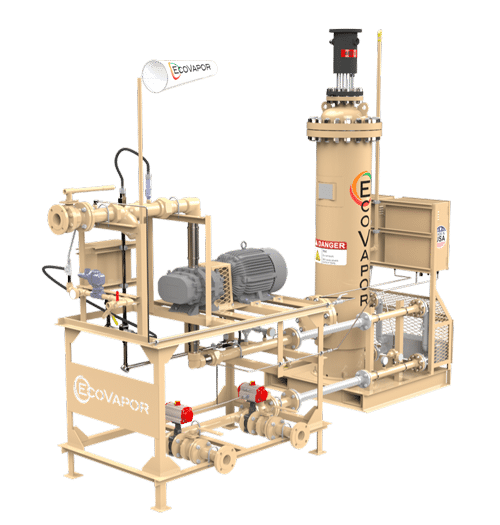
EcoVapor’s Tank Commander™ Vapor Management System (VMS) can help operators mitigate the risk of tank venting, which can lead to a super-emitter event. The Tank Commander VMS automatically and actively manages storage tank pressure, eliminating venting emissions. Importantly, the Tank Commander VMS is a life-of-well solution consisting of several models ranging in capacity from 2000 mscfd to 100 mscfd allowing you right-size treating capacity to natural production declines over time. The Tank Commander VMS captures and purifies the most valuable gas stream on location – tank vapors rich in valuable NGLs – preparing it for sale.
Tank Commander™ Vapor Management System (VMS)
The Tank Commander VMS automatically and actively manages storage tank pressure, eliminating venting emissions. The Tank Commander VMS captures and purifies the most valuable gas stream on location – tank vapors rich in valuable NGLs – preparing it for sale.
Compliance Benefits:
- By actively managing both positive and vacuum storage tank pressures resulting from changes in temperature, pressure, and natural tank “breathing,” the potential for releasing fugitive emissions of methane and VOCs is significantly mitigated.
- Reduces and eliminates fugitive emissions that might be detected in a periodic Leak Detection and Repair (LDAR) inspection by an Optical Gas Imaging (OGI) camera.
- Significantly mitigates the risk of a third-party detecting a Super Emitter event with satellite or airborne methane monitoring and reporting it to the EPA.
PRODUCT PAGE: Tank Commander™ Vapor Management System
READ MORE: CASE STUDY: Bison Oil & Gas Chooses Tank Commander™ Vapor Management System
EcoVapor for Profitable OOOOb Compliance
You no longer have to choose between meeting environmental performance goals and generating financial results – with EcoVapor you can achieve both. As it turns out, reducing emissions not only helps with environmental regulation compliance, but it also results in stronger economic performance by capitalizing on the opportunity to capture and profitably sell tank vapors rich in valuable NGLs, instead of combusting them or inadvertently losing them as fugitive emissions.
EcoVapor solutions deliver these additional benefits:
- Converts waste gas streams and fugitive emissions into revenue.
- Reduces routine tank flaring for meeting Voluntary Emissions Reduction initiatives.
- Improves site safety profiles.
- Achieve high reliability and uptime, with no moving parts in the ZerO2, minimal preventative maintenance, and field-wide runtime >99.8%.
- Both ZerO2 and Sulfur Sentinel come in multiple sizes for right-sizing equipment and align costs with natural production declines.
- Reduce Potential to Emit (PTE) for easier permitting.
- Simplify operations (no need for a Vapor Recovery Tower).
READ MORE: Zero Routine Flaring Targets Cannot Be Met Without Addressing Tank Battery Flaring and Venting
Summary
At a rate of 129 mscfd for uncontrolled emissions, the bar is low but the risks of having your operations identified as the source of a super-emitter event can be substantial. Fortunately there are solutions for mitigating them. EcoVapor offers a variety of proven solutions already working in the field for leading operators to help comply with the new regulations, avoid super-emitter events, and improve overall wellsite efficiency and economic performance.
Contact us today to learn more about how EcoVapor can help you achieve compliance and make money while doing it.
About EcoVapor
EcoVapor Recovery Systems, a DNOW Company, provides solutions to pressing oil and natural gas production problems. EcoVapor’s technical team has extensive expertise in vapor recovery processes, and includes world-class engineers with an innovative approach to industry challenges. In over 120 installations in all major US basins, our patented ZerO2 solution helps oil and gas producers meet their air emissions and regulatory compliance goals. EcoVapor is headquartered in Denver, Colorado and has field locations in Greeley, Colorado and Midland, Texas.
Contact
Joe Hedges
Director of Sales
EcoVapor Recovery Systems, a DNOW Company
7402 N. Elderidge Parkway, Houston, Texas 77041
E: joe.hedges@dnow.com
O: 844-NOFLARE (844-663-5273)