Blog posts from the EcoVapor website. Stay up to date with what’s going on.
In December 2021, the International Petroleum Industry Environmental Conservation Association (IPIECA) issued a joint report entitled Flaring Management Guidance as an aid to its members. The report outlines new developments in flaring management and reduction, and examines industry experiences with eliminating flaring, new technologies, business models, operational improvements and regulatory policy. It also features case studies and…
In 2017, PDC Energy identified a need to improve flow assurance while capturing tank vapor gas at a number of facilities in Colorado. This high-Btu gas was not able to be captured and sold when contaminated with oxygen, resulting in potential shut-in of the production facility or combustion of the gas with higher air emissions and…
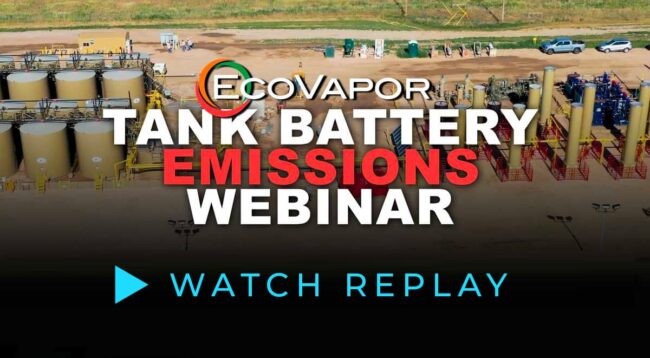
This Could Be The Most Important Webinar of the Year for Facilities EngineersEPA methane emissions estimates have guided operator actions and technology accordingly, but the latest “actual measured results” may surprise you. If you really want to make a dent in your emissions profile, you need to watch this video. Catch the replay of our…
Vapor Recovery Units, or VRUs, are commonly used in upstream oil and gas operations as well as many industrial applications to compress low-pressure gas. Examples include gas-lift, wellhead compression, tank battery vapor, and industrial tail gas recovery. The most common application is oil tank battery gas recovery, often immediately downstream of a Vapor Recovery Tower…
Renewable natural gas (RNG) is pipeline quality gas manufactured from the decomposition of organic matter, otherwise known as biogas. Access to a consistent supply of biogas is essential to a successful RNG effort, so where does biogas come from? In this article, we cover the most common sources of biogas. RNG Feedstocks The Environmental Protection…
What is Renewable Natural Gas (RNG)? Renewable natural gas (RNG) is pipeline quality gas manufactured from the decomposition of organic matter, otherwise known as biogas. To meet pipeline requirements, biogas must be upgraded to RNG or biomethane (biogas purification), so it can be sold commercially as compressed natural gas (CNG) or liquefied natural gas (LNG). …
Ensuring Gas is Pipeline Ready Leads to Zero Routine Flaring The Midland Reporter-Telegram (MRT) interviewed EcoVapor’s Jason Roe and Cody Blair on how our technology is helping oil and gas operators eliminate flaring and venting from tank batteries, helping them boost revenue and achieve their environmental performance goals. Excerpt: “‘This is cash everyone is burning.’…
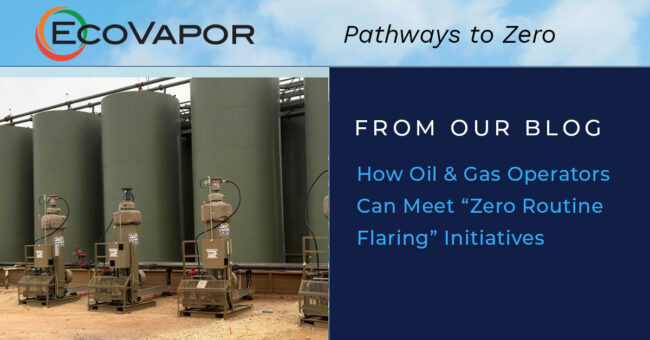
Why Are My Well Sites Still Flaring? In light of more stringent emissions rules and environmental performance mandates to achieve net-zero emissions and eliminate routine flaring, current production practices are being reexamined. In our first blog post on the subject Zero Routine Flaring Targets Cannot Be Met Without Addressing Tank Battery Flaring and Venting, we…
What is the Zero Routine Flaring (ZRF) Initiative? In light of more stringent emissions rules and environmental performance mandates to achieve net-zero emissions and eliminate routine flaring, current production practices are being reexamined. In 2015, The World Bank launched the Zero Routine Flaring (ZRF) initiative to encourage governments and upstream producers to eliminate the practice…
About MobileZero Each MobileZerO includes a ZerO2™ E300 unit, a Sulfur Sentinel™ unit and a dehydrator mounted on a trailer for convenient mobilization to well sites and production facilities that require temporary natural gas decontamination and treating capacity. The MobileZerO effectively purifies natural gas and vapors so they meet pipeline specification and can be sold…